
Why Freeze-Thaw Cycles Are a Serious Plumbing Threat in Central Texas
How freeze thaw cycles affect plumbing in Central Texas is something every homeowner in the Austin area needs to understand — especially because the damage often shows up not during the cold snap, but days later when temperatures rise again.
Here’s a quick summary of what’s happening to your pipes:
| What Happens | Why It Matters |
|---|---|
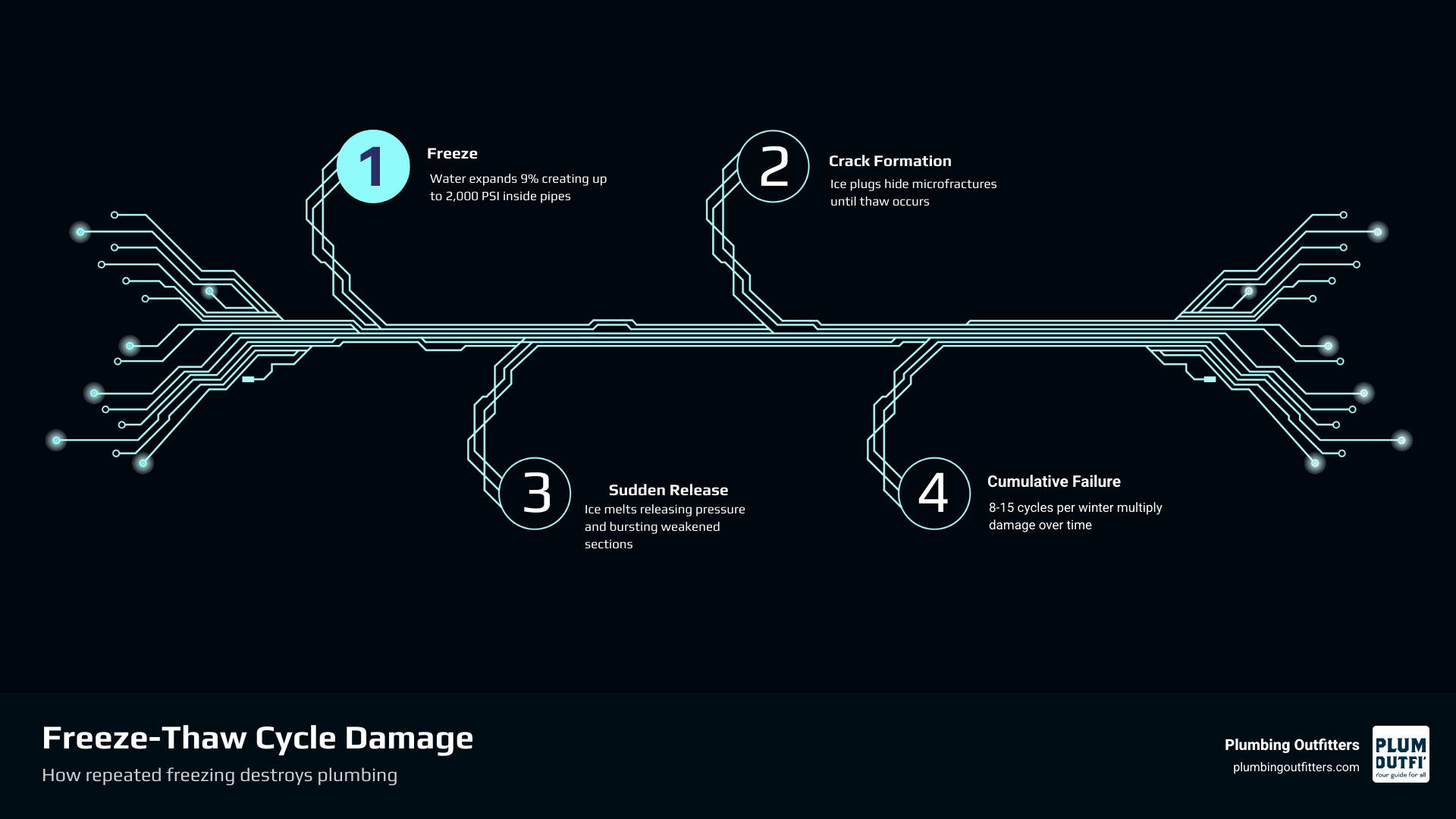
| Water freezes inside pipes and expands 9% | Creates up to 2,000+ PSI of internal pressure |
| Ice acts as a plug during the freeze | Masks cracks and damage until the thaw |
| Temperatures rise and ice melts | Pressure releases suddenly, bursting weakened pipe sections |
| Central Texas gets 8-15 freeze events per winter | Damage builds up over multiple cycles, not just one |
| Pipes in attics, crawl spaces, and exterior walls have no heat buffer | They experience the full force of every temperature swing |
Unlike northern states where pipes stay frozen through one long winter, Central Texas weather swings between freezing and warm temperatures repeatedly — sometimes within the same week. That repeated stress is what makes local plumbing so vulnerable. A pipe that survives the first freeze may quietly develop tiny cracks that grow with each subsequent cycle, until one thaw finally pushes it past its limit.
A burst pipe can release up to 250 gallons of water per hour into your home — and mold can start growing within just 24 to 48 hours of that water damage going undetected.
How Freeze Thaw Cycles Affect Plumbing in Central Texas
Living in Central Texas, we are used to wild weather swings. In the middle of winter, we can easily experience a 70°F afternoon followed by a sudden plunge into the low 20s. These rapid temperature fluctuations are the primary driver behind why Should You Really Be Concerned About Frozen Pipes During Texas Winters? is such a common question among homeowners in our region.
When winter storms roll through communities like Round Rock, Pflugerville, or Cedar Park, our plumbing systems bear the brunt of these rapid changes. Unlike homes in the Midwest or Northeast, which are built with deep basements and heavily insulated plumbing lines, Texas homes are optimized to shed heat during our long, grueling summers. Our water lines are frequently run through unconditioned attics, shallow crawl spaces, or right along drafty exterior walls.
When we experience 8 to 15 distinct freeze events in a single winter season rather than one prolonged, continuous freeze, our pipes undergo a process of cumulative stress. Each time the water inside a pipe freezes, the material expands. When it warms up, the pipe contracts. This constant “breathing” causes microscopic structural fatigue. Over several cycles, tiny microfractures develop along the pipe walls and at joint connections. You might not notice any issues during the first few cold snaps, but the structural integrity of your plumbing is steadily degrading behind your drywall.

The Science Behind How Freeze Thaw Cycles Affect Plumbing in Central Texas
To truly understand how freeze thaw cycles affect plumbing in Central Texas, we have to look at the physics of freezing water. Water is one of the few substances on Earth that expands when it transitions from a liquid to a solid. Specifically, water expands by approximately 9% in volume when it freezes.
When this expansion occurs inside a rigid pipe, it doesn’t just push outward against the pipe walls; it also compresses the remaining liquid water trapped between the newly formed ice blockage and closed plumbing fixtures (like a faucet or shutoff valve). This compression can create an astronomical amount of internal pressure — often exceeding 2,000 PSI (pounds per square inch). To put that in perspective, the typical water pressure in a residential home is only between 40 and 80 PSI.
When homeowners ask us, “Should You Really Be Concerned About Frozen Water Pipes During Texas Winters?” we explain that this 2,000+ PSI pressure is more than enough to rupture copper, break plastic joints, and split galvanized steel. What’s even more surprising to many is that the pipe rarely bursts directly at the point where the ice plug forms. Instead, the pressure builds downstream between the ice block and the closed faucet, causing the pipe to rupture in an area that might actually be completely free of ice.
Why the Thaw Phase is the Real Danger to Your Home
There is a common misconception that pipes burst at the exact moment they freeze. In reality, the thaw phase is when the true disaster unfolds.
During the freeze, the ice itself acts as a temporary pressure seal over any microfractures or physical splits that have developed in the pipe. The water is solid, so nothing leaks. However, as temperatures rise above freezing — which typically happens within a 72-hour window in Central Texas — the ice block begins to melt.
Once the ice plug liquefies, the full, unrestricted pressure of your municipal water supply rushes back through the system. This sudden return of pressure forces water directly through the newly formed cracks. If you aren’t home or aren’t paying close attention, a single split pipe can release up to 250 gallons of water per hour into your walls, ceilings, or crawl spaces.
This is why we stress watching for the 5 Signs You Need Help With Frozen Pipes in Austin TX as soon as the weather begins to warm up. If left unchecked, this volume of water can quickly lead to collapsed drywall, ruined flooring, and structural rot. To make matters worse, mold spores require only 24 to 48 hours of moisture exposure to begin colonizing your home’s structural framing.
High-Risk Areas and Vulnerable Pipe Materials
Every home has structural weak points where cold air can easily bypass insulation and reach your plumbing. In Central Texas, where slab foundations are incredibly common, our water lines often travel upward into uninsulated attics before dropping down into interior walls.
The most common high-risk zones in local properties include:
- Uninsulated Attics: In many ranch-style homes across Georgetown, Hutto, and Leander, water lines are routed through the attic. During a hard freeze, attic temperatures can be 30°F to 40°F colder than the heated living spaces below.
- Exterior Walls: Pipes running through walls that face the outside of the home are highly susceptible, especially if the wall insulation has settled over time.
- Crawl Spaces: Older pier-and-beam homes (frequently found in historic areas of West Lake Hills, Taylor, and Bastrop) have exposed underfloor plumbing that is highly vulnerable to freezing wind chills.
- Hose Bibbs (Outdoor Faucets): These are directly exposed to ambient outdoor temperatures and are almost always the first components to freeze.
- Garages: Many homeowners keep their water heaters in unheated garages, leaving the connecting supply lines exposed to freezing drafts.
Material Vulnerabilities: How Freeze Thaw Cycles Affect Plumbing in Central Texas
Different plumbing materials react uniquely to the stress of repeated freeze-thaw cycles. Understanding what kind of pipes you have in your home can help you assess your overall risk level.
| Pipe Material | Freeze-Thaw Resilience | Primary Failure Point | Behavior Under Pressure |
|---|---|---|---|
| Copper | Moderate to Low | Soldered joints & straight runs | Inelastic; develops pinhole leaks or splits after repeated cycles. |
| PEX Tubing | High | Brass/plastic fittings & connections | Highly flexible; can expand slightly to accommodate ice but fittings can still crack. |
| PVC / CPVC | Very Low | Glued joints & elbows | Extremely brittle in cold weather; cracks easily under impact or internal pressure. |
| Galvanized Steel | Low (with age) | Threaded joints & rusted sections | Rigid and strong, but age-related corrosion creates weak spots that split open. |
While PEX is highly resilient due to its natural flexibility, it is not completely freeze-proof. The tubing itself may expand and bounce back, but the rigid brass or plastic fittings that connect the lines cannot expand, making them highly vulnerable to cracking under pressure. Meanwhile, older galvanized pipes (common in older neighborhoods in Austin and Taylor) are prone to internal rusting, which creates thin walls that readily fail after just a few freeze-thaw cycles.
Warning Signs of Hidden Freeze-Thaw Damage
Because so much of your plumbing is tucked out of sight, a freeze-thaw cycle can cause structural damage that goes unnoticed for days or even weeks. Knowing the warning signs of a hidden leak can save you from catastrophic water damage and expensive restoration bills.
Be sure to review An Essential Guide to Frozen Pipe Repair in Austin TX and watch for these indicators:
- Unexplained Drops in Water Pressure: If your shower or kitchen faucet suddenly feels weak after a cold snap, water may be escaping from a broken pipe behind your walls.
- Damp Spots or Bubbling Drywall: Keep a close eye on your ceilings and walls, especially beneath attic pipe runs or near exterior walls.
- Musty, Earthy Odors: A persistent musty smell in a specific room or cabinet is a classic sign of slow-leaking water that has started to breed mold.
- Discolored Water: If your tap water suddenly looks rusty or brown, a split galvanized pipe may be drawing in dirt or accelerating internal corrosion.
- Sounds of Running Water: If you hear a faint hissing, dripping, or rushing sound when all your faucets are completely turned off, you likely have an active leak.
Practical Prevention and Safe Thawing Strategies
The best way to handle freeze-thaw damage is to prevent it from happening in the first place. Fortunately, taking a few proactive steps before the temperature drops below freezing can dramatically reduce your risk.
- Insulate Your Pipes: Install foam pipe sleeves over all accessible water lines in your attic, garage, and crawl space. For extreme trouble spots, consider wrapping pipes with UL-listed heat tape before applying the foam sleeves.
- Drip Your Faucets: When temperatures are forecast to drop below 28°F for more than a few hours, open your faucets to a slow, steady drip (about 5 drops per minute). Focus on faucets served by pipes running along exterior walls. This keeps water moving and relieves pressure buildup if an ice block does begin to form.
- Maintain Consistent Thermostat Settings: Never turn your heater off or set your thermostat below 55°F when traveling during the winter. Keeping your home consistently warm prevents cold air pockets from settling inside wall cavities.
- Open Cabinet Doors: Open the cabinet doors under your kitchen and bathroom sinks to allow warm indoor air to circulate around the plumbing.
For a comprehensive walkthrough on preparing your home for the winter, check out our guides on How to Protect Your Plumbing in a Freeze and How to Keep Your Pipes From Turning Into Popsicles This Winter.
Safe DIY Thawing Methods for Homeowners
If you turn on a faucet during a cold snap and only get a few sluggish drops, you likely have a frozen line. If you catch it early before the pipe actually bursts, you can safely thaw it yourself.
First, identify which pipe is frozen by tracing the line back from the affected fixture. Once you’ve located the frozen section, follow the steps outlined in How to Thaw Frozen Pipes in West Lake Hills TX in 3 Simple Steps:
- Keep the Faucet Open: As you warm the pipe, the melting ice will need an escape route for both water and steam pressure. Keeping the tap open also allows rushing water to help melt the remaining ice block.
- Apply Gentle Heat: Use a handheld hair dryer, an electric heating pad, or wrap the pipe in towels soaked in hot water. Start applying heat on the side closest to the open faucet and slowly work your way down the line.
- Never Use an Open Flame: Avoid blowtorches, propane heaters, or space heaters near exposed plumbing. Not only is this an extreme fire hazard, but intense, uneven heat can cause the water inside the pipe to boil rapidly, leading to a violent steam explosion.
When to Call a Professional Plumber
While DIY thawing is fine for accessible pipes under a kitchen sink, there are many scenarios where attempting a self-repair is highly risky. You should contact us immediately if:
- The frozen pipe is located in an inaccessible area, such as deep inside a wall cavity or high up in an unfloored attic.
- You see active leaking, spraying, or pooling water as the pipe begins to thaw.
- You cannot locate the main water shutoff valve to isolate your home in an emergency.
- You suspect multiple pipes have frozen throughout your home.
When dealing with active bursts, getting help from professionals who offer The Best Same-Day Frozen Pipe Repair in Austin TX is essential to minimizing property damage. Feel free to read through Detailed Reviews Top 10 Frozen Pipe Repair Austin TX to see how we’ve helped our neighbors navigate these stressful winter emergencies with fast, reliable service.
Frequently Asked Questions About Texas Freeze-Thaw Damage
Navigating winter plumbing issues can be confusing, especially with so much conflicting advice online. If you are facing a sudden emergency, we recommend checking out The 5 Best Emergency Frozen Pipe Repair West Lake Hills TX for immediate guidance. Below, we answer some of the most common questions we hear from Central Texas homeowners.
How many freeze-thaw cycles does it take to damage pipes?
Generally, it takes about 3 to 5 significant freeze-thaw cycles before a standard plumbing pipe experiences structural failure. However, this depends heavily on the age of your plumbing, the material of the pipes, and how cold the temperatures get.
Because the damage is cumulative, each individual cycle weakens the pipe slightly. A copper pipe might survive three minor freezes in December, only to burst on a relatively mild freeze in January because its structural integrity was already compromised.
Is PEX pipe completely freeze-proof?
No, PEX is highly freeze-resistant, but it is not completely freeze-proof. While PEX tubing can expand up to three times its normal diameter to accommodate expanding ice, the fittings (elbows, tees, and couplings) that connect the PEX lines are rigid.
During a severe freeze, the extreme pressure will often push the ice block down the line until it hits a brass or plastic fitting, causing the connection to crack or slip entirely.
Should I drip my faucets during every freeze warning?
You do not need to drip your faucets every time the temperature dips to 32°F. In Central Texas, pipes are generally safe until temperatures drop below 28°F for several consecutive hours.
We recommend dripping your faucets when a hard freeze warning is issued, or when temperatures are expected to stay below 28°F overnight. Focus on dripping the faucets that are connected to vulnerable pipes running along exterior walls or through unheated spaces.
Conclusion
Understanding how freeze thaw cycles affect plumbing in Central Texas is the key to protecting your home from devastating winter water damage. Because our local weather swings so rapidly between hard freezes and warm thaws, our pipes endure a level of cumulative stress that standard plumbing systems simply weren’t designed to handle.
By taking simple, proactive steps — like insulating exposed pipes, dripping faucets during hard freezes, and knowing how to safely thaw a frozen line — you can keep your home safe through the winter months.
If you do find yourself facing a frozen pipe or a sudden burst, don’t wait for the damage to spread. Whether you need emergency assistance or want to schedule a pre-winter plumbing inspection, our team is here to help.
Discover why your neighbors trust us by reading about the 5 Reasons Why You Will Love Emergency Frozen Pipe Repair Taylor TX or exploring the Top 10 Freezing Pipes Plumbers West Lake Hills TX.
Ready to secure your home’s plumbing against the next big temperature swing? Schedule professional plumbing services with Plumbing Outfitters today and experience our signature “Texas Class Service” firsthand!