
What Homeowners Need to Know About How a Tankless Water Works
How does a tankless water heater work? Here’s the short answer: when you turn on a hot water tap, cold water flows into the unit, a flow sensor detects the movement, and either a gas burner or electric heating element fires up instantly to heat the water as it passes through a heat exchanger. Hot water reaches your faucet in seconds — and keeps flowing for as long as you need it. The heater shuts off automatically the moment you close the tap.
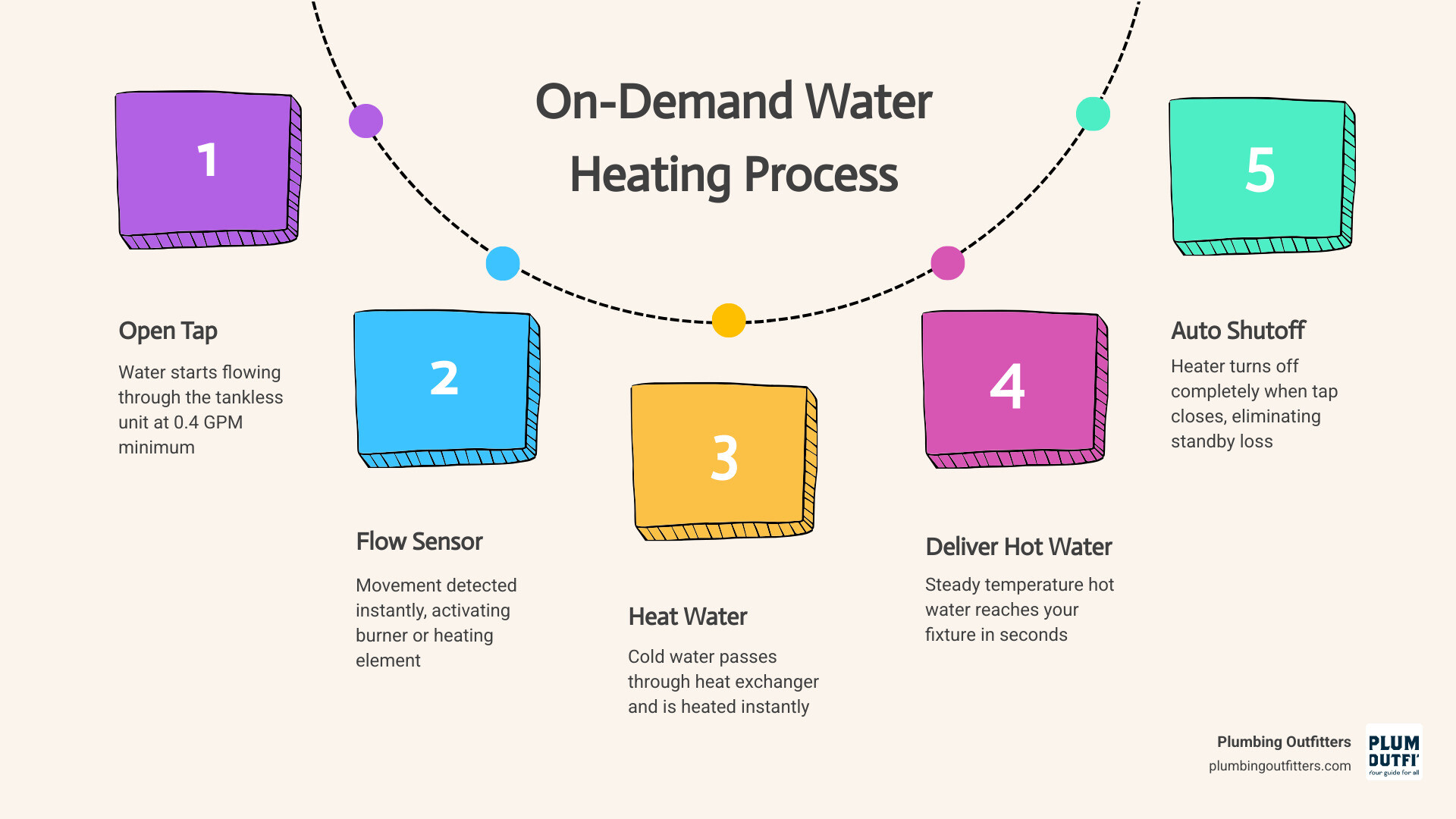
The on-demand heating process at a glance:
- You open a hot water tap — this starts water moving through the unit
- The flow sensor activates — detecting movement at as little as 0.4 GPM
- The burner or heating element fires — heating the water instantly inside the heat exchanger
- Hot water flows to your fixture — at a steady, set temperature
- You close the tap — the heater shuts off completely, using zero standby energy
Unlike a traditional tank water heater — which keeps 40 to 50 gallons of water hot around the clock whether you need it or not — a tankless system only runs when you actually need hot water. That elimination of standby heat loss is the core reason these systems can be significantly more energy efficient for most households.
If you’ve ever wondered why your energy bills stay high even when you’re careful about usage, your water heater keeping a full tank warm 24 hours a day is likely a big part of the answer. Tankless water heaters solve that problem at the source.
This guide from Plumbing Outfitters covers everything Central Illinois and Austin-area homeowners need to understand about how these systems work, how to choose the right one, and how to keep it running efficiently for years to come.
How Does a Tankless Water Heater Work?

To truly understand how these compact systems deliver an endless stream of hot water, we have to look inside the box. A tankless water heater is a marvel of modern engineering, packing a complex sequence of thermodynamics and digital control into a cabinet about the size of a carry-on suitcase.
At its core, the system relies on a few key components working in perfect harmony:
- The Flow Sensor: This is the gatekeeper. It constantly monitors the water line. When you open a tap and water starts moving through the system at a rate of at least 0.4 to 0.5 gallons per minute (GPM), the sensor alerts the control board.
- The Microprocessor: Think of this as the brain of the operation. It receives data from the flow sensor, the incoming water temperature sensor, and the outgoing water temperature sensor. It calculates exactly how much heat is needed to reach your desired setpoint.
- The Heat Exchanger: This is where the magic happens. A heat exchanger is a network of tightly coiled copper or stainless steel pipes surrounded by heat-conducting fins. Copper is highly favored for its exceptional thermal conductivity. As cold water travels through these narrow pipes, heat from the burner or electric coils transfer directly to the water.
- The Burner or Heating Elements: In a gas unit, a modulating gas valve opens and electronic igniters spark to light the burner. In an electric unit, heavy-duty heating elements submersed in or wrapped around the exchanger cycle on.
By eliminating the massive storage reservoir, these units free up valuable square footage in your utility closet or garage. If you want a deep dive into the foundational concepts of this technology, check out our guide on Everything You Need to Know About Going Tankless.
Step-by-Step: How Does a Tankless Water Heater Work When You Turn on the Tap?
Let’s trace the exact path of water and energy from the moment you turn the shower handle:
- Flow Detection: Cold water enters the bottom of the unit. The flow sensor detects the movement and sends a signal to the microprocessor.
- System Check & Ignition: The microprocessor runs a rapid safety check. If everything is clear, it commands the gas valve to open and ignites the burner (or activates the electric relays).
- Heat Transfer: The intense heat generated by the burner or elements warms the outer surface of the heat exchanger. As the cold water winds through the internal copper tubes, it absorbs this thermal energy rapidly.
- Temperature Regulation: The microprocessor continuously monitors the outgoing water temperature. If the incoming water gets colder, it modulates the gas flame up or increases the electric current. If you turn down the shower flow, it scales the heat back to prevent scalding.
- Continuous Flow: Hot water exits the unit and travels to your faucet. This cycle continues indefinitely as long as the tap remains open.
- Automatic Shutdown: When you turn off the faucet, the flow sensor registers that water has stopped moving. The burner or heating elements shut down immediately, and the unit goes back into a silent, energy-saving standby mode.
Sizing Your System: Flow Rate and Temperature Rise
When homeowners ask us how to choose a tankless model, we tell them it all comes down to two numbers: Flow Rate and Temperature Rise.
- Flow Rate (GPM): This is the total volume of hot water you expect to use at any single moment. For example, a typical shower uses about 2.0 GPM, a washing machine uses 1.5 GPM, and a kitchen sink uses 1.5 GPM. If you want to run all three at the same time, your tankless unit must be rated for at least 5.0 GPM.
- Temperature Rise: This is the difference between the temperature of the cold water entering your home (groundwater temperature) and the temperature you want at your tap (usually set to 120°F).
In our Greater Austin, TX service area—including Round Rock, Georgetown, and Cedar Park—groundwater temperatures are relatively warm, averaging around 65°F to 70°F year-round. This means we only need a temperature rise of about 50°F to 55°F to reach a comfortable 120°F. Because the temperature rise is moderate, a tankless unit installed in Texas can produce a much higher GPM output than the exact same unit installed in a freezing northern climate.
To explore how different models match up with your household’s daily habits, take a look at Tankless Water Heater Options Faster Hot Water for Every Household.
Condensing vs. Non-Condensing Tankless Water Heaters
If you are shopping for a gas-powered tankless water heater, you will quickly run into two distinct categories: condensing and non-condensing. The difference lies in how they handle waste heat and exhaust, which has a massive impact on both energy efficiency and installation requirements. You can learn more about how these categories impact your utility bills in our article on Energy Efficiency Tankless Water Heaters.
Understanding the Condensing Process
A condensing tankless water heater is the gold standard of energy efficiency. It features two heat exchangers: a primary exchanger and a secondary exchanger.
As cold water enters the unit, it passes through the secondary heat exchanger first. This secondary exchanger captures the residual heat from the burner’s exhaust gases, preheating the water before it even reaches the main burner. By extracting so much heat from the exhaust, the temperature of the escaping gas drops significantly (down to around 130°F).
Because the exhaust is cooled so dramatically, it condenses into liquid water inside the unit. This condensation is highly acidic, requiring a built-in condensate neutralizer and a dedicated drain line. However, because the exhaust is cool, we can vent these units using inexpensive PVC pipe rather than expensive metal venting.
Non-Condensing Systems Explained
Non-condensing tankless water heaters are the traditional design. They feature a single heat exchanger. Because they only pass the water through one heating phase, a significant amount of heat escapes directly into the exhaust pipe.
The exhaust gases from a non-condensing unit can reach temperatures of 300°F to 400°F. Because the exhaust is so hot, it does not condense into liquid, meaning you do not need a condensate drain. However, you must use specialized, corrosion-resistant stainless steel venting to safely channel these hot gases out of your home.
In warm climates like Austin, Bastrop, and West Lake Hills, non-condensing units are occasionally installed on the exterior of the house, which eliminates the need for complex indoor venting entirely.
Tankless vs. Traditional Tank Water Heaters
How do these modern on-demand systems stack up against the classic metal cylinders that have sat in our basements and garages for decades? Let’s look at a direct comparison:
| Feature | Tankless Water Heater | Traditional Tank Water Heater |
|---|---|---|
| Energy Source | Gas or Electricity (On-Demand) | Gas or Electricity (Continuous) |
| Standby Energy Loss | None | High (Constantly reheating water) |
| Physical Footprint | Small (Wall-mounted, saves space) | Large (Takes up significant floor space) |
| Lifespan | 20+ Years | 10 to 15 Years |
| Hot Water Capacity | Endless (Subject to GPM limits) | Limited (Runs out when tank empties) |
| Maintenance Need | Annual descaling / flushing | Occasional tank flushing |
For a broader look at this matchup, read our detailed comparison on Tankless vs Tank Water Heater What’s the Difference or dive into The Great Water Heater Debate Tankless vs Traditional.
Lifespan and Durability Differences
One of the most compelling reasons to go tankless is sheer longevity. A traditional tank water heater is constantly subjected to the corrosive effects of storing hot water. Over time, minerals settle at the bottom, and the tank eventually rusts out, typically lasting only 10 to 15 years before requiring complete replacement.
A tankless water heater, by contrast, is designed to last 20 years or more with proper care. Because they do not store water, the internal components are far less prone to catastrophic rust-through failures. Furthermore, almost every component inside a tankless unit—from the sensors to the heat exchanger—is individually replaceable. If a part wears out, we can swap it out, whereas a leaking traditional tank almost always means buying a whole new system.
Energy Efficiency and Long-Term Savings
The financial argument for tankless systems centers on eliminating standby energy loss. According to data from the U.S. Department of Energy:
- For homes that use 41 gallons or less of hot water daily, tankless water heaters can be 24% to 34% more energy efficient than conventional storage tanks.
- For busy households using around 86 gallons per day, they still provide an 8% to 14% energy efficiency boost.
While the initial installation requires a higher upfront investment, the monthly utility savings combined with a lifespan that is double that of a standard tank means these systems frequently pay for themselves over time. To see the math broken down for your household, read Will a Tankless Water Heater Actually Save You Money.
Choosing Between Gas and Electric Tankless Models
Once you decide to go tankless, your next big choice is the fuel source. Both gas and electric models have unique advantages and highly specific home infrastructure requirements. To see how these compare to other alternative systems, check out Solar vs Electric Water Heater Which One is Better.
Gas Tankless Water Heaters
Gas-fired tankless water heaters are the heavy lifters of the industry. They utilize natural gas or liquid propane to produce massive amounts of thermal energy quickly, measured in BTUs (British Thermal Units).
- Performance: Gas units generally offer much higher GPM flow rates, making them the best option for whole-house systems in larger homes with multiple bathrooms.
- Requirements: They require a dedicated venting system to exhaust combustion gases safely. Additionally, because they must heat water instantly, they require a large burst of gas when they fire up. This often means upgrading your home’s gas line from a standard 1/2-inch pipe to a larger 3/4-inch pipe, and occasionally upgrading your gas meter.
Electric Tankless Water Heaters
Electric tankless units use high-powered electrical resistance coils to heat water.
- Performance: They are incredibly efficient, often exceeding 98% thermal efficiency because there is no heat lost through an exhaust vent. They are compact, silent, and do not require any venting, making them perfect for tight closets or point-of-use installations (like under a kitchen sink).
- Requirements: The catch with whole-home electric tankless heaters is their massive electrical demand. A whole-house electric unit can easily draw 120 to 150 amps of power. This usually requires a 200-amp or 300-amp main electrical panel upgrade, multiple dedicated double-pole circuit breakers, and heavy-gauge wiring.
Installation Requirements and Essential Maintenance
Switching to a tankless system is not a simple “plug-and-play” swap. Because these units operate differently than traditional tanks, they have strict installation and maintenance codes that must be followed. Failing to install them correctly can void your warranty or create serious safety hazards. For a list of pitfalls to avoid, read about the 10 Common Mistakes in Tankless Heater Installation and consult our Switching Tank Tankless Complete Guide.
Critical Installation Upgrades
When our professional plumbers install a tankless system in homes across Pflugerville, Round Rock, or Georgetown, we evaluate several critical infrastructure points:
- Venting Codes: Gas units must be vented according to strict manufacturer specifications. This often involves running concentric venting (a pipe-within-a-pipe system where fresh air is drawn in through the outer ring and exhaust is pushed out the center) through an exterior wall.
- Gas Line Sizing: As mentioned, a tankless gas burner can require up to 200,000 BTUs. We must ensure your existing gas line can handle this capacity without starving your stove or furnace of fuel.
- Hard Water Mitigation: The municipal water supply in Greater Austin is notoriously hard, averaging 120 to 180 ppm (parts per million) of dissolved minerals. When hard water is heated rapidly inside the narrow copper pathways of a tankless heat exchanger, calcium and magnesium scale can deposit quickly. We highly recommend pairing your tankless system with a whole-home water softener to protect your investment.
How Does a Tankless Water Heater Work with Regular Maintenance?
To keep your tankless water heater running at peak efficiency for 20+ years, regular maintenance is non-negotiable.
Because water passes through very small channels in the heat exchanger, mineral scale buildup acts as an insulating barrier, forcing the burner to run hotter and longer to heat the same amount of water. Left unchecked, scale can cause the heat exchanger to overheat and crack.
We recommend an annual descaling flush:
- Isolate the Unit: Close the hot and cold water valves to isolate the heater from the rest of your home.
- Connect a Pump Kit: Hook up submersed pump hoses to the built-in service isolation valves.
- Circulate Vinegar: Pump food-grade white vinegar or an approved descaling solution through the unit for 45 to 60 minutes. The acid safely dissolves the calcium buildup.
- Clean the Sediment Filter: Remove and clean the built-in water inlet screen filter to remove any pebbles or rust flakes.
- Flush and Restore: Flush the unit with fresh water, disconnect the hoses, and open your service valves.
Frequently Asked Questions About Tankless Water Heaters
Can a tankless water heater run out of hot water?
No, a properly sized tankless water heater will never “run out” of hot water because it heats water continuously on demand. You can take a two-hour shower, and the water will be just as hot at the end as it was at the start. However, you can overwhelm the system if you exceed its maximum GPM flow rate. If you try to run two showers, the washing machine, and the dishwasher simultaneously, the unit may not be able to keep up, resulting in a drop in water pressure or temperature.
Do tankless water heaters work in cold climates?
Yes, but they require careful sizing. In cold northern climates, incoming winter groundwater can drop to 40°F or lower. This requires a much higher temperature rise (around 80°F) to reach a comfortable output temperature, which reduces the unit’s maximum GPM capacity. In our Central Texas service areas—including Leander, Hutto, and Taylor—our mild winters mean our incoming water rarely drops below 55°F, allowing our tankless units to maintain excellent flow rates all year long.
How long do tankless water heaters last compared to tank models?
With proper maintenance, tankless water heaters routinely last 20 to 25 years. Traditional tank water heaters, on the other hand, typically last only 10 to 15 years before the tank corrodes and leaks. Regular descaling to prevent mineral buildup is the single most important factor in maximizing the lifespan of your tankless system. To learn more about why these units are so durable, check out Tips on Why Tankless Water Heaters are So Popular.
Conclusion
A tankless water heater is an exceptional investment for homeowners seeking endless hot water, lower utility bills, and a clutter-free utility space. By heating water only when you need it, these systems eliminate standby energy waste and deliver unparalleled efficiency.
Because installing and maintaining these advanced systems requires specialized knowledge of gas lines, complex venting codes, electrical loads, and hard water mitigation, it is a job best left to the professionals.
At Plumbing Outfitters, we deliver “Texas Class Service” to homeowners throughout Greater Austin, including Round Rock, Georgetown, Cedar Park, Pflugerville, and the surrounding areas. Whether you need a system flush, a repair, or a complete tank-to-tankless conversion, our experienced, neighborly plumbers are here to help.
Ready to upgrade your home’s comfort? Explore our Services Tankless Water Heater page, read up on The Ultimate Guide to Tankless Water Heater Benefits for Homeowners, or learn about the Top Benefits of Switching to a Tankless Water Heater.
When you’re ready for a personalized consultation, visit our Austin Tankless Water Heater Austin TX page to schedule an appointment with our trustworthy local team!