


The Great Water Heater Debate Tankless vs Traditional
The Great Water Heater Debate: What Austin Homeowners Need to Know in 2026
A tankless vs tank water heater comparison comes down to five key factors: upfront cost, energy efficiency, hot water supply, lifespan, and space requirements. Here’s a quick breakdown before we dive deeper:
| Factor | Tank Water Heater | Tankless Water Heater |
|---|---|---|
| Hot Water Supply | Limited by tank size; can run out | Continuous, on-demand |
| Energy Efficiency | Lower; heats water 24/7 | Higher; heats only when needed |
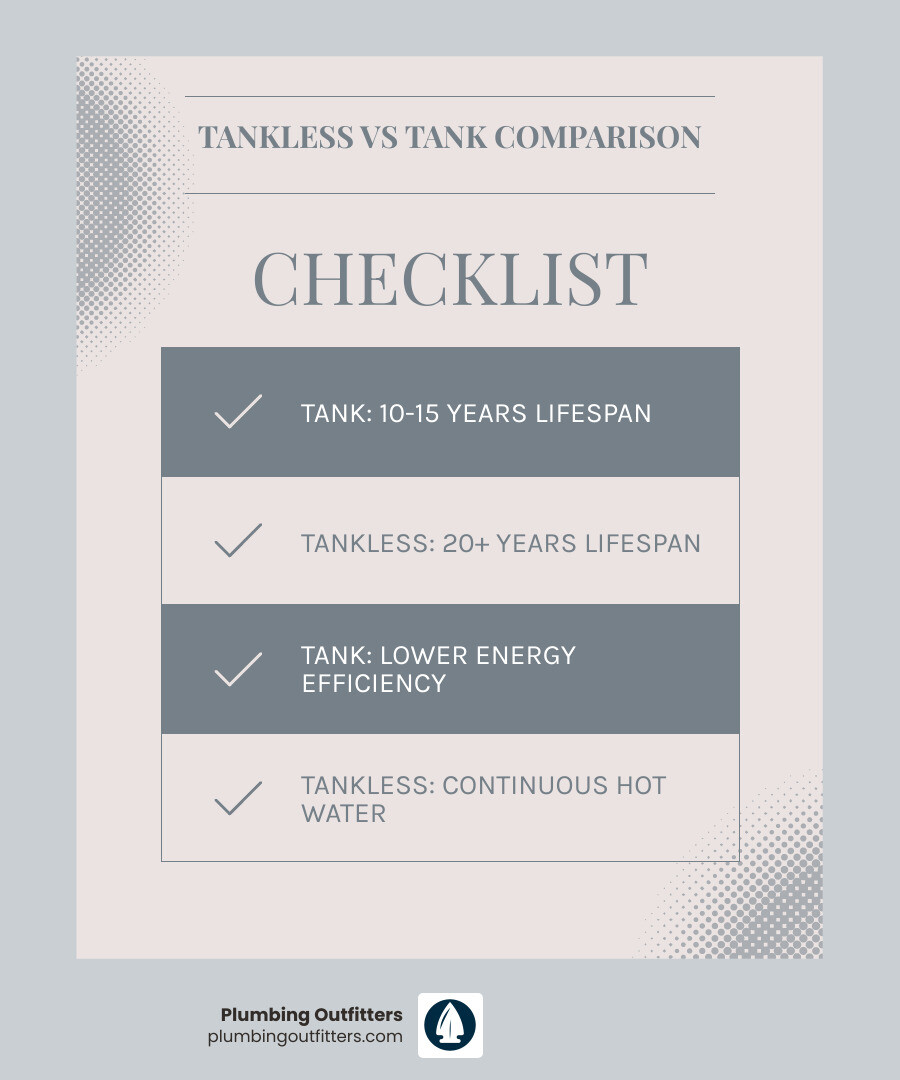
| Lifespan | 10-15 years | 20+ years |
| Space | Large (roughly 2 ft wide, 5-6 ft tall) | Compact (about the size of a suitcase) |
| Installation | Simpler, lower cost | More complex, higher upfront cost |
| Best For | Budget-conscious buyers, high simultaneous demand | Energy savers, space-limited homes |
Your water heater quietly handles every hot shower, load of laundry, and dishwasher cycle in your home. Most homeowners never think about it — until it fails, or until the energy bill creeps up month after month. In Austin, where hard water and rising energy costs are everyday realities, choosing the right water heater matters more than most people realize.
The two main options — traditional storage tank and tankless (on-demand) — work in fundamentally different ways. Each has real advantages and genuine drawbacks. The right choice depends on your household size, how you use hot water, and your long-term plans for your home.
This guide lays out everything you need to make a confident, informed decision.
Operational Mechanics: How They Heat Your Water
To understand the tankless vs tank water heater comparison, we have to look under the hood. While both machines have the same goal—getting you hot water—they go about it in completely opposite ways.
Traditional Tank Water Heaters
A traditional unit is essentially a large, insulated silo. Whether you are sleeping, at work in Round Rock, or vacationing, that tank is working. It keeps 30 to 80 gallons of water at a steady 120–140 degrees Fahrenheit. This leads to something called standby loss. Because the tank is constantly losing heat to the surrounding air, the burners or heating elements must frequently kick on to “top off” the temperature. It’s a bit like keeping a pot of water simmering on the stove all day just in case you want tea at 4:00 PM.
Tankless Water Heaters
Tankless units, often called “on-demand” or “instantaneous” heaters, eliminate the big vat of water entirely. When you flip the hot water handle on your faucet, a sensor detects the flow. This triggers a high-powered heat exchanger—fueled by gas or electricity—that flash-heats the water as it travels through the unit.
Because there is no storage, there is no standby loss. You only pay to heat the water you actually use. For a deeper look at these mechanical differences, you can explore our guide on Tankless Vs Tank Water Heater What S The Difference.
Tankless vs tank water heater comparison: Efficiency and Performance
Efficiency is where the tankless vs tank water heater comparison gets interesting for your wallet. In April 2026, energy efficiency is a top priority for most Greater Austin residents.
- Energy Factor (EF): This rating measures how much of the energy used actually goes into heating the water. Tankless units boast thermal efficiency ratings of 95% to 99%, while older gas tanks might hover around 60% to 70%.
- Daily Savings: For homes using 41 gallons or less of hot water daily, tankless systems can be 24%–34% more energy efficient than conventional tanks. Even in high-usage homes (around 86 gallons a day), they remain 8%–14% more efficient.
- Annual Impact: On average, a tankless unit can save a household about $44 to $110 per year in energy costs, depending on the fuel source.
For more details on how these ratings translate to your monthly bills, check out our resource on Energy Efficiency Tankless Water Heaters.
How a tankless vs tank water heater comparison affects hot water delivery
Efficiency is great, but performance is what you feel in the shower.
- Endless Water: The biggest “pro” for tankless is the infinite supply. If you have a large family in Cedar Park or a massive soaking tub, a tankless unit won’t run out. A tank, once emptied, requires a “recovery period” to heat the next batch.
- The “Cold Water Sandwich”: This is a common tankless quirk. If you turn the shower off to soap up and then flip it back on, you might get a few seconds of hot water (left in the pipe), followed by a “sandwich” of cold water (the water that passed through before the heater re-fired), before it gets hot again.
- Flow Rate Limits: Tankless units are measured in Gallons Per Minute (GPM). If you try to run two showers, the dishwasher, and the laundry at once, a tankless unit might struggle to keep up, resulting in lukewarm water. A tank system, while limited in total volume, can usually handle multiple simultaneous taps better until the tank is empty. If you’re struggling with performance, our article Not Enough Hot Water This Can Help offers practical solutions.
Choosing the right model based on a tankless vs tank water heater comparison
In the Austin area, our groundwater temperature averages around 65°F to 75°F. This is a huge advantage! In colder climates like Minnesota, where groundwater is 45°F, a tankless unit has to work twice as hard to reach 120°F. Here in Central Texas, our warmer “starting” temperature means tankless units can achieve higher GPM flow rates, making them a very effective choice for our region.
When we help neighbors in Leander or Georgetown choose a model, we look at “Peak Hour Demand.” This is the maximum amount of hot water your family needs during its busiest hour (usually the morning rush). You can learn more about finding your perfect fit at Tankless Water Heater Options Faster Hot Water For Every Household.
Lifespan, Reliability, and Maintenance Requirements
A water heater is a long-term investment. If you’re planning to stay in your home for decades, the tankless vs tank water heater comparison tilts heavily toward on-demand systems.
- Lifespan: Traditional tanks typically last 10 to 15 years. Tankless units are built to last 20 years or more, with some well-maintained systems reaching the 30-year mark.
- Corrosion Control: Tanks rely on an anode rod—a sacrificial metal rod that attracts corrosive elements so the tank lining doesn’t rust. If this rod isn’t replaced every 3-5 years, the tank will eventually burst. Nearly 75% of tank failures involve leaks or bursts that can spill 30 to 80 gallons of water into your home.
- The Hard Water Factor: Austin is famous for its hard water. High mineral content causes scale buildup. In a tank, this sediment settles at the bottom, acting as an insulator that makes the heater work harder. In a tankless unit, scale can clog the narrow passages of the heat exchanger.
Maintenance is mandatory for tankless units. To keep your warranty valid and the system running, you need an annual “descaling” or “flushing” with a vinegar solution. For tips on keeping your system in top shape, see Extending A Water Heaters Life and our Top Tips For Spring Water Heater Maintenance.
Space Requirements and Installation Considerations in Austin Homes
Space is a major factor in the tankless vs tank water heater comparison, especially in modern homes or renovations in West Lake Hills.
- The Footprint: A standard 50-gallon tank takes up about 9 square feet of floor space. Tankless units are about the size of a small suitcase and are mounted on the wall, freeing up valuable floor space in closets or garages.
- Venting and Infrastructure: This is where the “hidden” aspects of the comparison lie. If you are retrofitting an old home in Taylor to go tankless, you may need to:
- Upgrade your gas line to a larger diameter to handle the high BTU demand.
- Install specialized PVC venting (for condensing models) or stainless steel venting.
- Upgrade your electrical panel if you are choosing an electric tankless model, as they draw significant amperage.
Because of these complexities, professional installation is a must to ensure safety and code compliance. We discuss these requirements further in our guide on Gas Water Heater Replacement What You Need To Know.
Frequently Asked Questions about Water Heaters
We hear many of the same questions from our customers in Hutto and Pflugerville. Here are the most common concerns regarding the tankless vs tank water heater comparison.
Is a tankless unit better for large families in Austin?
It depends on how you use water. If your family takes back-to-back showers, a tankless unit is a “no-brainer” because it will never run out. However, if everyone tries to shower at the exact same time in different bathrooms, you will need a unit with a high GPM rating (usually 9–11 GPM) or even two smaller units to ensure everyone has enough pressure and heat.
How often should I flush my water heater?
In the Greater Austin area, we recommend flushing your water heater once a year. Because of our local hard water, calcium and magnesium buildup happens faster here than in other parts of the country. Regular flushing protects the heat exchanger and ensures you don’t lose efficiency.
Can I switch from a tank to a tankless system easily?
“Easily” is a relative term! While it’s not a simple “plug-and-play” swap, it is a very common upgrade. The main hurdles are the venting and gas line requirements mentioned earlier. While the upfront labor is more involved than a simple tank swap, most homeowners find the space savings and endless hot water well worth the transition.
Conclusion
Choosing between a tank and a tankless water heater isn’t about finding the “best” machine; it’s about finding the best machine for your home. If you want the lowest upfront cost and simple maintenance, a traditional tank is a reliable workhorse. If you prioritize energy savings, want to reclaim closet space, and never want to experience a cold shower again, tankless is the way to go.
At Plumbing Outfitters, we specialize in helping Austin homeowners navigate these choices. We pride ourselves on “Texas Class Service,” providing upfront pricing and a neighborly experience you can trust. Whether you’re in Bastrop, Round Rock, or anywhere in between, our experienced plumbers are ready to help you find the perfect water heating solution.
Ready to upgrade your home comfort? Explore our Services/Water Heater page or give us a call today for an expert consultation.