

Will a Tankless Water Heater Actually Save You Money
Do tankless water heaters save money over time through energy efficiency?
Do tankless water heaters save money over time? Yes — for most Austin-area homeowners who plan to stay in their home long-term, tankless water heaters do save money, primarily by eliminating standby energy loss and lasting significantly longer than traditional storage tanks.
Here’s a quick summary:
- Energy efficiency: Tankless units are 24%–34% more efficient for homes using 41 gallons or less of hot water daily, and 8%–14% more efficient for higher-usage homes
- Annual savings: The U.S. Department of Energy estimates gas-fired tankless heaters save an average of $108 per year over traditional tank models
- Lifespan: Tankless units typically last 20+ years, compared to 10–15 years for storage tanks — meaning you may replace a tank twice before a tankless unit needs replacing
- Payback period: Ranges from roughly 6–27 years depending on fuel type, installation complexity, and household usage
- Tax credits: Qualifying ENERGY STAR certified models may be eligible for federal tax credits in 2026, which can meaningfully shorten the payback window
So the short answer is yes — but how much you save, and how fast you save it, depends on several factors specific to your home.
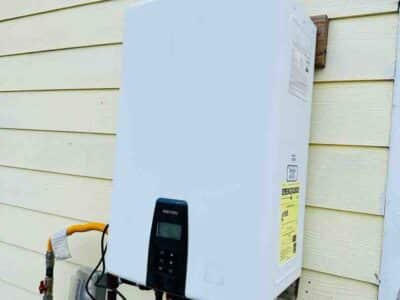
Here’s what most homeowners don’t realize: a traditional storage tank water heater keeps 40–80 gallons of water hot around the clock, whether you need it or not. That constant reheating — called standby heat loss — quietly drains energy every single day. A tankless (or demand-type) water heater sidesteps this entirely. Cold water flows through a heat exchanger and is warmed instantly, only when a faucet is opened.
The efficiency gains are real and well-documented. But so are the upfront costs and installation considerations. Whether a tankless system is the right financial move for your Austin home depends on how you weigh the long-term savings against the initial investment — and that math looks different for every household.
This guide walks through all of it: energy savings, payback timelines, maintenance costs, lifespan advantages, and the situations where sticking with a tank heater might actually make more financial sense.
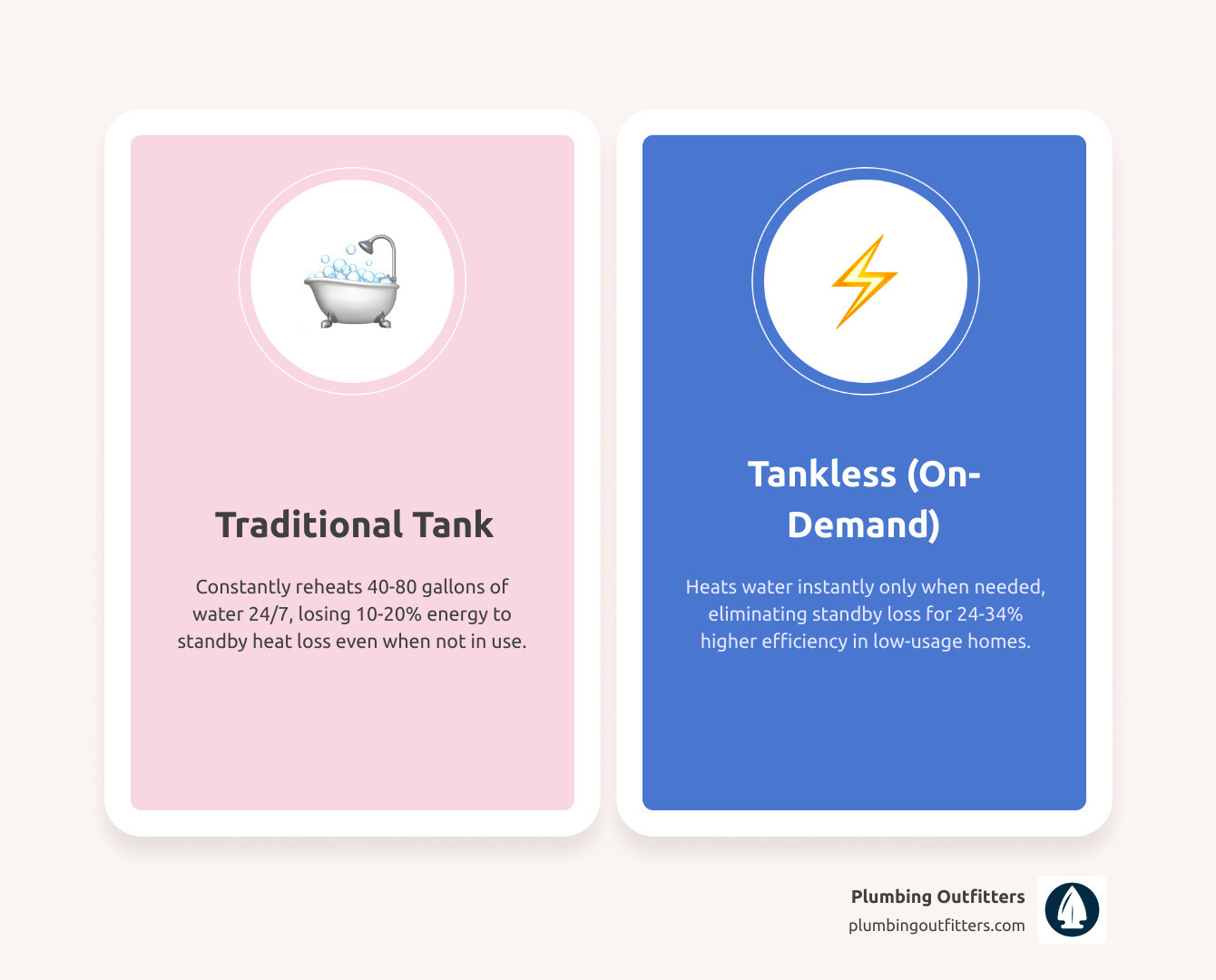
The primary way these systems put money back in your pocket is through sheer operational efficiency. In a standard home, water heating is typically the second-largest energy expense. Traditional tanks suffer from “standby loss,” which accounts for about 10% to 20% of your water heating costs. This is essentially energy spent keeping a giant drum of water hot while you’re at work or sleeping.

When we look at the Tankless vs. Tank Water Heater: What’s the Difference?, the most glaring gap is the Uniform Energy Factor (UEF). Modern condensing tankless models often boast UEF ratings of 0.95 or higher, meaning 95% of the energy consumed goes directly into heating your water. Compare that to standard gas tanks, which often hover between 0.60 and 0.70 UEF.
| Feature | Traditional Tank Heater | Tankless Water Heater |
|---|---|---|
| Energy Efficiency (UEF) | 0.60 – 0.70 | 0.95+ (Condensing models) |
| Standby Energy Loss | High (Continuous reheating) | None (On-demand only) |
| Energy Savings (Daily) | Baseline | 8% – 34% Higher |
| Ignition System | Often Standing Pilot Light | Intermittent Ignition Device (IID) |
One of the “secret weapons” of a modern tankless unit is the secondary heat exchanger found in condensing models. This technology captures extra heat from exhaust gases that would otherwise be wasted, using it to pre-heat incoming cold water. Additionally, most units now use an Intermittent Ignition Device (IID) rather than a standing pilot light, ensuring gas is only used the moment you turn on the tap.
How do tankless water heaters save money over time with federal tax credits?
As we move through 2026, the financial incentive to go green has never been stronger. The federal government continues to reward homeowners who choose high-efficiency appliances. If you opt for an ENERGY STAR certified gas tankless model with a UEF of 0.95 or higher, you may be eligible for significant federal tax credits.
In 2026, these IRS incentives can offset a portion of your investment, effectively lowering the “net” cost of the upgrade. When you combine these with local utility rebates — like those occasionally offered by Austin Energy or other providers in Central Texas — the initial financial hurdle becomes much easier to clear. For more on the specifics of high-efficiency upgrades, check out our guide on Gas Water Heater Replacement: What You Need to Know.
Why do tankless water heaters save money over time compared to traditional tanks?
Beyond the monthly gas or electric bill, there is the matter of “Total Cost of Ownership.” Traditional tanks are prone to internal rust and sediment buildup because they are constantly holding water. This eventually leads to the dreaded tank failure, often resulting in a flooded garage or laundry room. Knowing the Five Signs It’s Time to Replace Your Hot Water Heater can help you avoid these disasters.
Tankless units are built with corrosion-resistant materials like copper or stainless steel and are designed with replaceable components. If a part breaks in a tankless unit, we can often swap it out. If a traditional tank leaks, the entire unit is usually headed for the landfill.
Furthermore, tankless units offer “space reclamation.” By removing a bulky 5-foot-tall tank, many of our neighbors in Pflugerville and Round Rock have gained enough square footage to expand a pantry or add storage to a garage. These are just a few Tips on Why Tankless Water Heaters Are So Popular in modern Texas homes.
Calculating the Payback Period for Your Austin Home
The “payback period” is the amount of time it takes for your energy savings to equal the extra money you spent on the initial installation. In the Greater Austin area, this calculation is influenced by several local factors.
First, consider your fuel source. Natural gas is generally very cost-effective in Texas, making gas-fired tankless units a popular choice for those looking for a faster ROI. Electric tankless units are nearly 99% efficient at the point of use, but because electricity costs more per unit of energy than gas, the monthly bill savings might be less dramatic. You can dive deeper into these metrics on our page about Energy Efficiency Tankless Water Heaters.
Groundwater temperature also plays a role. In Central Texas, our water doesn’t get as bone-chillingly cold as it does in the North, which means your tankless unit doesn’t have to work as hard to reach a comfortable 120°F. This lower “temperature rise” requirement allows for better flow rates and higher efficiency year-round.
Finally, household size is the biggest variable. A family of five in Cedar Park that runs the dishwasher, laundry, and back-to-back showers will see much higher total energy savings than a single person living in a condo. To explore different models and their capacities, visit our Tankless Water Heater Category.
Long-Term Value: Lifespan and Maintenance Considerations
A tankless water heater is a marathon runner, not a sprinter. While a standard tank might give up the ghost after 10 or 12 years, a well-maintained tankless unit can easily reach a 20-year life expectancy. This longevity is a massive factor when asking do tankless water heaters save money over time, as it effectively cuts your replacement frequency in half.
However, that lifespan depends heavily on maintenance, especially given the hard water common in places like Georgetown and Liberty Hill. Mineral scale (calcium and magnesium) can build up inside the heat exchanger, acting as an insulator that forces the unit to work harder and eventually causes damage.
We highly recommend annual professional descaling — a process where we flush the system with a food-grade solution to dissolve scale. We provide specialized Tankless Water Heater Services in Georgetown to keep these systems running at peak efficiency.
Other maintenance tasks include:
- Inlet filter cleaning: Checking the screen that catches sediment from the city water lines.
- Venting inspection: Ensuring the air intake and exhaust are clear of debris or obstructions.
- Anode rod check: Some units utilize small rods to prevent internal corrosion.
To see what can go wrong when these steps are skipped, read about the 10 Common Mistakes in Tankless Heater Installation. For our neighbors further east, we also offer dedicated Tankless Water Heater Services in Taylor.
When a Tankless Upgrade Might Not Make Financial Sense
We believe in “Texas Class Service,” which means being honest with our customers even when it means recommending a simpler solution. There are specific scenarios where a tankless unit might not provide a good return on investment.
The biggest hurdle is often the “retrofit infrastructure.” Tankless units have different requirements than tanks:
- Gas line diameter: They often require a 3/4-inch gas line to handle the high-BTU “burst” needed for instant heating, whereas many older Austin homes only have 1/2-inch lines.
- Venting requirements: Gas units need specialized stainless steel or PVC venting (depending on the model) that must be routed to the exterior.
- Electrical service: Whole-house electric tankless units can pull 120 to 200 amps, which might necessitate a costly panel upgrade.
If your home requires $5,000 in infrastructure upgrades just to support the unit, your payback period could stretch beyond 25 years. In such cases, a high-efficiency Tank Water Heater Austin TX might be the more sensible financial choice. You can learn more about these cost variables in our breakdown of How Much Does Replacing a Water Heater Cost?.
Additionally, if you plan on selling your home in the next two years, you won’t live there long enough to reap the energy savings. While it may add “green appeal” to your listing, you likely won’t recoup the full installation cost in the sale price.
Frequently Asked Questions about Tankless Savings
How much energy does a tankless heater save daily?
On average, a tankless heater uses 24% to 34% less energy than a traditional tank for households using about 41 gallons of hot water daily. For very high-usage homes (86+ gallons), the savings are closer to 8% to 14%. While the percentage is lower for high-usage homes, the total dollar amount saved is often higher because the overall energy consumption is greater.
Does Austin’s hard water affect my long-term savings?
Yes. Hard water is the “silent killer” of tankless efficiency. Without regular flushing or a water softener, scale buildup can reduce heat transfer efficiency, causing your energy bills to creep back up. We recommend a water softener for the best long-term ROI in Central Texas, as it protects not just your water heater, but all your plumbing fixtures.
Can I install a tankless unit myself to save money?
We strongly advise against DIY installation for tankless systems. These units involve high-voltage electricity or high-pressure gas, specialized venting, and precise calibration. Most manufacturers will void your warranty if the unit isn’t installed by a licensed professional. A poor installation can also lead to the “cold water sandwich” effect or premature system failure, wiping out any potential savings.
Conclusion
At Plumbing Outfitters, we want to help you make the best decision for your home and your wallet. Do tankless water heaters save money over time? For the majority of long-term homeowners in Greater Austin, the answer is a resounding yes. Between the eliminated standby losses, the 20-year lifespan, and the added convenience of endless hot water, the value proposition is hard to beat.
Whether you are interested in the Top Benefits of Switching to a Tankless Water Heater or you simply need a reliable Tankless Water Heater Austin TX expert to evaluate your current setup, we are here to help.
If you’re ready to stop paying to heat water you aren’t using, contact us today. Our experienced plumbers provide upfront pricing and neighborly service across the entire region. Explore our full range of Water Heater Services and let’s find the perfect fit for your Texas home.