

Why some plumbing jobs are strictly for the pros
The Plumbing Issues That Require a Licensed Plumber — And Why It Matters
Plumbing issues that require a licensed plumber are more common than most homeowners realize — and getting them wrong can mean serious damage, failed inspections, or voided insurance. Here’s a quick look at the jobs you should never hand off to a handyman or tackle yourself:
Plumbing jobs that require a licensed plumber:
- Sewer line backups and main line clogs — blockages affecting multiple fixtures signal a main line problem, often involving tree root intrusion or collapsed pipe
- Gas line repairs or installations — any work on natural gas lines carries explosion and carbon monoxide risks
- Water heater replacement or repair — especially gas-fired or tankless units, which involve both gas and electrical connections
- Burst or leaking pipes behind walls or under slabs — hidden leaks cause structural damage and mold growth that DIY fixes rarely catch
- Low water pressure diagnosis — can indicate corroded pipes, hidden leaks, or pressure regulation failures
- New fixture installations that require permits — any work that modifies your supply lines or drain-waste-vent system typically requires a permit and inspection
- Sewer lateral repairs — work on the line connecting your home to the municipal sewer must meet local code standards
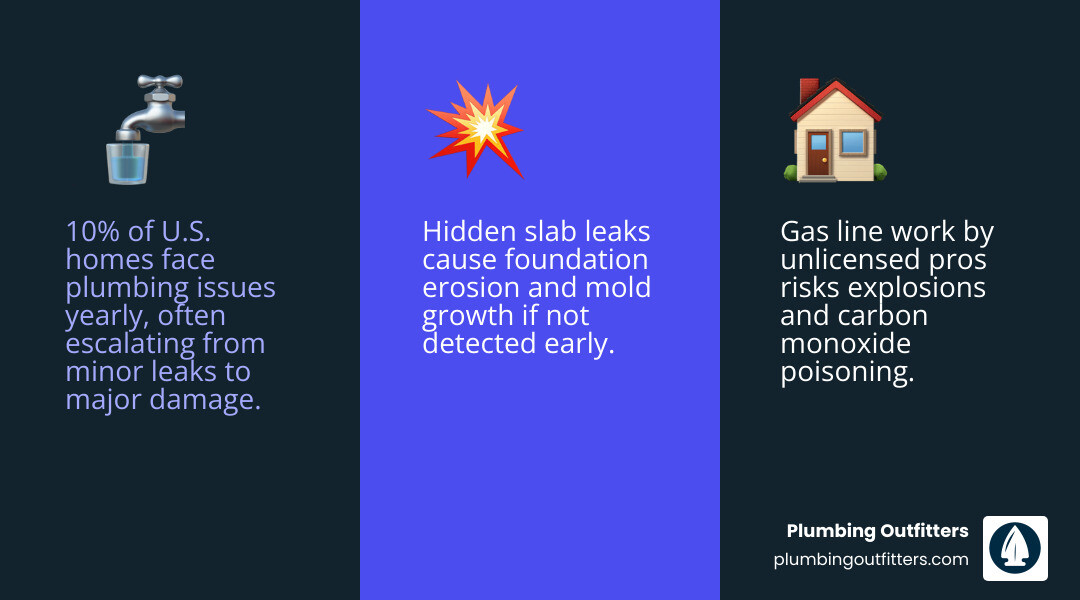
Approximately 10% of U.S. homes deal with plumbing issues every year, according to WifiTalents. Many of those problems start small — a dripping faucet, a slow drain, a slight drop in water pressure — and quietly grow into structural emergencies or health hazards. In the Greater Austin area, where shifting soils and hard water put extra stress on plumbing systems, knowing which jobs belong to a licensed professional isn’t just smart — it’s essential for protecting your home and your family.
This guide walks you through exactly which plumbing issues require a licensed plumber, why DIY attempts often backfire, and what to look for when choosing a pro you can trust.
I’m dealing with a major leak. Which plumbing issues that require a licensed plumber should I worry about?
When water is gushing from a pipe or pooling in your yard, the panic is real. In these moments, it is tempting to grab some waterproof tape or a patch kit and hope for the best. However, major leaks—especially those involving the main water line or the sewer lateral—are high-stakes plumbing issues that require a licensed plumber.
The main water line is the artery of your home. It operates under significant pressure, typically ranging from 40 to 80 pounds per square inch (psi) according to the International Plumbing Code (IPC §604.4). If this line fails, it isn’t just a “drip” situation; it can release hundreds of gallons of water in a matter of hours, leading to foundation erosion or a collapsed ceiling. Because these lines are often buried deep underground or hidden behind structural walls, repairing them requires specialized excavation equipment and an understanding of local code compliance.
Furthermore, any repair that involves the sewer lateral—the pipe that carries waste from your house to the city’s main—is strictly regulated. You cannot simply dig a hole and swap out a pipe. Most municipalities in Central Texas require specific permits and inspections for this work. Attempting a DIY fix on a sewer line can lead to legal headaches and may even prevent you from selling your home in the future if the work wasn’t performed by a licensed professional and inspected by the city. When things take a turn for the worse after hours, knowing when to call a Georgetown emergency plumber can save you from a catastrophic property loss.
Managing sewer line backups and main line clogs
A clogged kitchen sink is one thing, but when every drain in your house starts gurgling or backing up simultaneously, you aren’t dealing with a simple clog. You’re likely facing a main sewer line blockage. In our experience across Austin and Round Rock, the most frequent culprit is tree root intrusion. Tree roots are incredibly strong and can exploit even the tiniest hairline crack in a sewer pipe, eventually filling an 8-inch lateral in just 5 to 10 years.
This is a scenario where a plunger or a store-bought chemical cleaner simply won’t cut it. In fact, we strongly advise against those harsh chemicals; they can damage your pipes and are often ineffective against deep blockages. Licensed plumbers use advanced technology like CCTV camera inspections to see exactly what is happening inside the line. Once the problem is identified, we use professional-grade tools like hydro-jetting, which uses water pressure between 1,500 and 4,000 PSI to clear out roots and debris without destroying the pipe.
It is also a matter of health. Sewer backups involve “Category 3” water, which is grossly contaminated with pathogens. Exposure to this water or the hydrogen sulfide gas (sewer gas) that accompanies it can be dangerous. According to OSHA, hydrogen sulfide is considered a life-safety hazard at high concentrations. If you notice a slow draining sink: when it’s time to call a pro is usually when the problem moves beyond a single fixture and starts affecting the whole house.
Handling dangerous gas line plumbing issues that require a licensed plumber
Perhaps the most critical plumbing issues that require a licensed plumber are those involving gas lines. Many homeowners are surprised to learn that plumbers handle gas piping, but it’s a core part of our licensure. Natural gas is incredibly efficient for heating and cooking, but it is also explosive and carries the risk of carbon monoxide poisoning if not vented correctly.
Gas lines can fail for several reasons. In older homes in places like Taylor or Elgin, we often see electrolysis—a process where dissimilar metals come into contact and cause rapid pipe deterioration. We also see issues with improper installations by unlicensed individuals who didn’t use the correct sealant or support brackets.
If you smell a “rotten egg” odor, that is the mercaptan added to natural gas to alert you to a leak. In this situation, you should evacuate immediately and call for help. Once the area is safe, a licensed plumber must be the one to perform the repairs. We follow strict safety protocols and pressure-test the entire system to ensure there are zero leaks before the gas is turned back on. There are at least 5 reasons to hire a plumber for gas pipe installation, with family safety being the absolute top priority.
Why DIY repairs in Greater Austin often lead to bigger headaches
We love the “can-do” spirit of our neighbors in Central Texas, but plumbing is one area where DIY often turns “do-it-yourself” into “disaster-it-yourself.” The problem is that plumbing systems are interconnected. A small change in one area can cause a pressure spike or a drainage vacuum in another.
| Feature | DIY Approach | Professional Licensed Plumber |
|---|---|---|
| Tools | Basic wrenches, manual snakes | Hydro-jets, fiber-optic cameras, acoustic sensors |
| Code Knowledge | Often ignored or unknown | Strict adherence to IPC and local amendments |
| Diagnosis | Guesswork based on symptoms | Root-cause identification via diagnostics |
| Long-term Cost | High (due to recurring issues) | Low (repairs are done right the first time) |
| Safety | High risk (gas, sewage, electrical) | Managed via training and safety protocols |
One of the biggest risks of DIY is hidden damage. You might stop a visible leak under the sink, but if you didn’t address the high water pressure that caused the leak, you’ll soon have a burst pipe behind a wall. This leads to mold growth, which can start in as little as 24 to 48 hours. Furthermore, there is the issue of insurance. Many homeowners’ insurance policies have clauses that refuse coverage for water damage if the repairs were performed by an unlicensed individual. Understanding what could happen if you use an unlicensed plumber for repairs is the first step in realizing that a professional is a long-term investment in your home’s value.
Detecting hidden leaks and slab failures
In areas like Pflugerville and Hutto, the soil is known for expanding and contracting, which puts immense stress on concrete slabs and the pipes buried beneath them. A “slab leak” is one of the most evasive plumbing problems a homeowner can face. You might notice a warm spot on the floor, a spike in your water bill, or the sound of running water when everything is turned off.
These are plumbing issues that require a licensed plumber because they are impossible to find without specialized tools. We don’t just start jackhammering your floor. We use acoustic sensors to “listen” for the sound of escaping water and infrared imaging to find temperature anomalies behind walls or under floors. Detecting these issues early prevents foundation erosion, which can cost tens of thousands of dollars to fix if the house starts to settle unevenly. Deciding between a local plumber or DIY: when to call a professional usually comes down to whether the problem is visible or hidden. If it’s hidden, call us.
Who in Austin specializes in complex installations and system upgrades?
Upgrading your home’s fixtures or installing a new water heater isn’t just about connecting pipes; it’s about engineering a system that works efficiently and safely. Modern plumbing fixtures, especially high-efficiency toilets and tankless water heaters, have specific requirements for venting and flow rates defined by the International Plumbing Code (IPC).
When we handle an installation, we aren’t just looking at the new unit. We evaluate the entire system. For example, if you are switching to a tankless water heater, your existing gas line might not be large enough to handle the increased BTU demand. Or, if you are installing a new shower valve, we need to ensure it has the proper pressure-balancing features to prevent “shower shock” (sudden temperature changes). Finding the best plumber services: spotting quality repairs and installations means looking for a team that understands these technical nuances.
Troubleshooting water heater plumbing issues that require a licensed plumber
The average conventional water heater lasts about 10 years, but in the Greater Austin area, our hard water can shorten that lifespan significantly. Water is classified as “hard” if it contains more than 7 grains of minerals per gallon, and much of our local water exceeds that. This leads to sediment buildup, which acts as an insulator, making your heater work harder and eventually causing the tank to overheat and fail.
There are several plumbing issues that require a licensed plumber when it comes to water heaters:
- T&P Valve Failures: The Temperature and Pressure relief valve is a critical safety feature. If it fails, your water heater can literally become a rocket.
- Anode Rod Replacement: This “sacrificial” rod prevents the tank from rusting. Most homeowners don’t know it exists, but replacing it every few years can double the life of your heater.
- Thermal Expansion: If you have a “closed” plumbing system, heating water causes it to expand, which can stress your pipes and water heater tank. We install expansion tanks to handle this extra pressure safely.
Don’t wait until you’re taking a cold shower to think about your heater. You should find a reliable Austin plumber to protect your home and schedule annual maintenance to flush out sediment and check these vital components.
Frequently Asked Questions about professional plumbing
What are the signs of a hidden pipe leak?
Common indicators include an unexplained increase in your water bill, musty odors (which suggest mold), damp spots on drywall, or a “ticking” sound behind walls. You can also check your water meter; if the leak indicator is moving while all faucets are off, you definitely have a leak. Because these are often plumbing issues that require a licensed plumber, we use electronic leak detection to find the source without tearing your house apart.
Can I replace my own water heater?
While some big-box stores sell water heaters to the public, we don’t recommend DIY installation. In many parts of Central Texas, including Round Rock and Cedar Park, a permit is required for water heater replacement. Furthermore, if you have a gas heater, an improper connection can lead to gas leaks or improper venting of carbon monoxide. A licensed professional ensures the unit is up to code, properly vented, and safely connected.
Why is my water pressure so low?
Low water pressure can be caused by something simple like a clogged aerator, but it can also signal a major problem. If the low pressure is house-wide, it could be a failing pressure-reducing valve (PRV), a major hidden leak, or internal corrosion in older galvanized steel pipes (which typically start failing after 40 to 70 years). A plumber can perform a pressure test to determine if the issue is a simple fix or a sign of a larger system failure.
Conclusion
At Plumbing Outfitters, we believe that your home deserves “Texas Class Service.” Whether you are in Austin, Georgetown, or Liberty Hill, our team is dedicated to providing honest, upfront pricing and repairs that stand the test of time. Plumbing isn’t just about fixing leaks; it’s about ensuring the health and safety of your family and the structural integrity of your biggest investment.
Don’t let a small drip turn into a major disaster. If you’re facing any of the plumbing issues that require a licensed plumber mentioned today, reach out to us. From advanced leak detection to expert water heater repair, we have the experience and the tools to do the job right the first time.
If you are ready to experience the difference that professional, neighborly service makes, learn how to find the best Austin TX plumber or visit our services page to see how we can help you today. We proudly serve the entire Greater Austin area, including Hutto, Leander, and West Lake Hills, ensuring your plumbing system remains reliable year-round.