
The Hot Take on Upgrading to a Tankless System
The Hot Take on Whether a Tankless Water Heater Is Worth the Upgrade
Is a tankless water heater worth the upgrade? For most homeowners, the answer is yes — but with some important conditions attached.
Here’s the quick version:
- Stay long-term? A tankless unit’s 20+ year lifespan and energy savings make strong financial sense.
- Small to medium household? You’ll likely see 24%–34% greater energy efficiency compared to a standard tank.
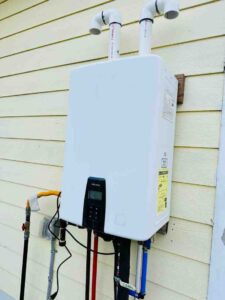
- Limited space? Tankless units are roughly the size of a carry-on suitcase and mount to the wall.
- High simultaneous demand? Sizing matters — an undersized unit will disappoint.
- Planning to move soon? The higher upfront investment may be harder to recoup.
Most Central Illinois homeowners who switch report the biggest wins from never running out of hot water, reclaiming floor space, and avoiding the risk of a tank rupture causing thousands of dollars in water damage.
That said, the upgrade isn’t right for everyone. Your household size, water usage, existing gas or electrical infrastructure, and how long you plan to stay in your home all factor into whether going tankless is the smart move.
Here’s what you actually need to know before making the decision.

Is a tankless water heater worth the upgrade for your home?
When we talk to homeowners in Austin, Round Rock, or Pflugerville about their hot water, the conversation usually starts because their old tank is leaking or they’re tired of the “icy surprise” at the end of a shower. To determine if is a tankless water heater worth the upgrade, we have to look at the long-game.
A traditional water heater is essentially a large, insulated thermos. It keeps 40 to 50 gallons of water hot 24 hours a day, regardless of whether you’re sleeping, at work, or on vacation. This leads to “standby energy loss.” A tankless system, however, only fires up when you turn on a tap.
| Feature | Traditional Storage Tank | Tankless Water Heater |
|---|---|---|
| Lifespan | 8–12 Years | 20+ Years |
| Energy Efficiency | Standard | 24%–34% Higher (low use) |
| Hot Water Supply | Limited to tank size | Endless (on-demand) |
| Space Required | 9–12 Square Feet | Wall-mounted (Suitcase size) |
| Risk of Flooding | High (40-80 gallon rupture) | Low (No large reservoir) |
The Top Benefits of Switching to a Tankless Water Heater go beyond just lower monthly bills. For many of our neighbors in Taylor and Hutto, the space-saving aspect is a game-changer. Imagine reclaiming that hallway closet or opening up 10 square feet in your garage. Furthermore, because these units don’t store water, they aren’t prone to the same rust and sediment issues that cause traditional tanks to eventually fail and flood your home. Considering the average water heater flood causes $4,000 to $10,000 in damage, the peace of mind alone is often worth the switch.
Deciding if a tankless water heater worth the upgrade for large families
For a large family in Leander or Cedar Park, the “endless hot water” promise is the primary selling point. We’ve all been there: the third person in line for the morning shower gets the lukewarm leftovers. With a tankless system, the hot water doesn’t run out because it’s being created in real-time.
However, “endless” does not mean “infinite volume.” This is where sizing becomes critical. We measure this in Gallons Per Minute (GPM). A typical shower uses about 2 GPM. If you have a large family and want to run two showers while the dishwasher is going, you need a unit that can handle at least 5–7 GPM.
Gas-fired tankless models generally produce higher flow rates than electric ones, making them the preferred choice for larger Texas households. If you’re curious about which model fits your lifestyle, exploring Tankless Water Heater Options: Faster Hot Water for Every Household can help you visualize the right capacity for your home.
Technical requirements for a tankless water heater worth the upgrade
One reason the initial installation for a tankless system is more involved than a tank swap is the infrastructure. These units are high-performance machines that require specific “fuel” and “breathing” room.
- Gas Line Diameter: A standard tank heater uses about 40,000 BTUs. A tankless unit can require up to 199,000 BTUs to heat water instantly. This often means we need to upsize your gas line from a 1/2-inch to a 3/4-inch pipe to ensure the unit doesn’t “starve” for fuel when it kicks on.
- Venting: Because gas tankless units burn more fuel at once, they produce hotter exhaust. They require specialized Category III stainless steel venting or, in the case of modern condensing models, specific PVC venting that can handle the condensation.
- Electrical Capacity: Even gas models need a dedicated outlet for the control board. If you’re going with an electric tankless model, you might need a significant upgrade to your electrical panel—sometimes requiring up to four 40-amp breakers.
Avoiding 10 Common Mistakes in Tankless Heater Installation is vital. If the gas pressure is too low or the venting is incorrect, the unit will throw error codes and shut down, leaving you with no hot water at all.
Understanding the Mechanics: Tank vs. Tankless
To truly grasp why the efficiency varies, you have to look under the hood. In a traditional tank, a sacrificial anode rod hangs inside the water to attract corrosive elements. Once that rod is gone, the tank starts to rust.
In a tankless system, a flow sensor detects when you’ve opened a hot water tap. This triggers the heat exchanger—the heart of the unit. Cold water travels through these heated coils and exits at your desired temperature within seconds. When you turn the tap off, the unit stops burning energy immediately.
This eliminates standby heat loss, which accounts for a significant portion of your water heating costs. When comparing Tankless vs Tank Water Heater: What’s the Difference?, the most striking technical difference is the “repairability.” Most parts in a tankless unit, like the heat exchanger or the sensors, can be replaced. When a tank rusts out, the whole thing is junk. This is why tankless units can easily last 20 to 25 years with proper care.
Long-Term Performance and Maintenance in Greater Austin
We have to talk about the “elephant in the room” for Central Texas homeowners: hard water. Whether you’re in Georgetown, Bastrop, or San Marcos, our water is full of minerals.
In a tankless unit, these minerals can “bake” onto the heat exchanger. Over time, this scale acts like an insulator, forcing the unit to work harder and eventually causing it to overheat or fail. If you ignore maintenance, a unit meant to last 20 years might only last 10.
Annual Descaling is Non-Negotiable.
To keep your system running at peak efficiency, we perform a maintenance flush once a year. This involves circulating a food-grade descaling solution (or vinegar) through the unit to dissolve mineral buildup. We also clean the internal filters that catch sediment before it reaches the heat exchanger.
If you have a water softener, your maintenance needs will be lower, but we still recommend a professional check-up to ensure the sensors and venting remain clear. Our Tankless Water Heater Services are designed to protect your investment and keep your warranty valid, as many manufacturers require proof of annual maintenance.
When to Stick with a Traditional Storage Tank
As much as we love tankless technology, it isn’t the perfect fit for every scenario. There are times when a high-quality traditional tank is actually the better choice for your wallet and your home.
- Short-Term Living: If you plan on moving in the next two to four years, you won’t live in the home long enough to see the energy savings offset the higher installation cost.
- Tight Budgets: If your water heater dies unexpectedly and you don’t have the budget for gas line or venting upgrades, a standard tank swap is much faster and more affordable upfront.
- Extreme Simultaneous Demand: In very large homes where four or five showers might run at once, a single tankless unit may struggle. In these cases, a large-capacity tank or multiple tankless units would be required.
- Electric-Only Homes with Small Panels: If your home has a 100-amp electrical service, adding a whole-home electric tankless unit could require a total panel upgrade, making the project much more expensive.
In The Great Water Heater Debate: Tankless vs Traditional, we often tell our clients in places like Rockdale or Granger that a well-maintained, high-efficiency tank is still a very reliable piece of equipment.
Frequently Asked Questions about Tankless Upgrades
How long does a tankless water heater actually last?
With proper maintenance—specifically annual descaling—a tankless water heater typically lasts 20 to 25 years. This is nearly double the lifespan of a traditional tank, which usually starts showing signs of failure between 8 and 12 years.
Can a tankless unit handle two showers at the same time?
Yes, provided it is sized correctly. A unit with a flow rate of 7 to 10 GPM can comfortably handle two showers and a kitchen sink simultaneously. However, in the winter, when the incoming groundwater in Texas is colder, the unit has to work harder to “rise” to the target temperature, which can slightly reduce the flow rate.
Does a tankless water heater require more maintenance than a tank?
It requires different maintenance. While you should flush a traditional tank to remove sediment, most people don’t. A tankless unit requires an annual flush to prevent mineral scale from destroying the heat exchanger. It’s a bit like an oil change for your car; skip it, and the engine won’t last.
Conclusion
So, is a tankless water heater worth the upgrade in 2026? If you value endless hot water, want to save 24%–34% on your energy usage, and plan to stay in your home for the long haul, it is one of the best upgrades you can make. It’s an investment in comfort, efficiency, and home safety.
At Plumbing Outfitters, we specialize in providing “Texas Class Service” to our neighbors throughout Greater Austin. Whether you’re in Manor, Pflugerville, or West Lake Hills, we can help you evaluate your home’s infrastructure and determine if a tankless system is the right fit for your family. From the initial sizing to the specialized venting and long-term maintenance, we’ve got you covered.
If you’re ready to stop worrying about your old water tank and start enjoying on-demand hot water, check out Everything You Need to Know About Going Tankless or reach out to us today to schedule an assessment. We’re here to ensure your home stays comfortable, one gallon at a time.