
Why Summer Heat Is a Bigger Threat to Your Plumbing Than You Think
How summer heat affects your plumbing system is something most homeowners don’t think about until something goes wrong — a sudden spike in the water bill, a soggy patch in the yard, or a pipe that gives out on the hottest day of the year.
Here’s a quick look at the main ways summer heat puts your plumbing at risk:
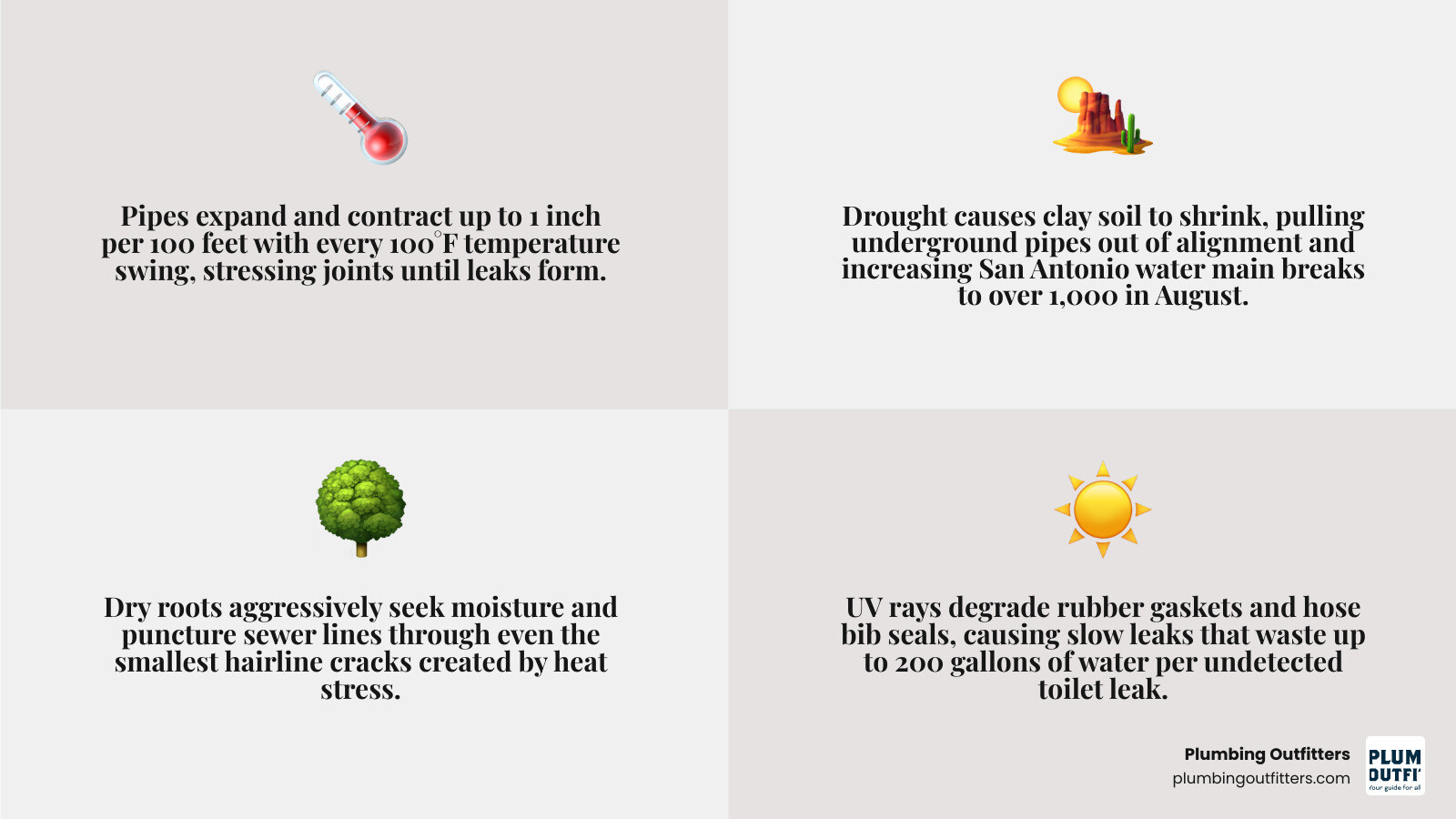
- Thermal expansion — Pipes expand and contract daily as temperatures rise and fall, wearing down joints over time
- Soil shifting and drought — Dry, cracked soil pulls away from underground pipes, causing them to sag, misalign, or snap
- Tree root intrusion — Roots seek moisture more aggressively in dry conditions, often targeting small cracks in sewer lines
- Increased water demand — Higher usage from irrigation, pools, and extra showers strains older pipes and drops water pressure
- UV and heat damage to outdoor fixtures — Sun exposure dries out rubber seals and gaskets, causing slow leaks at hose connections and faucets
- Water heater stress — Greater demand combined with sediment buildup makes water heaters work harder and wear out faster
The numbers back this up. In San Antonio, water main breaks more than doubled — jumping from around 470 per month early in the year to over 1,000 in August during a record-breaking summer. In Houston, calls for water leaks hit 500 per week during peak heat. These aren’t isolated events. They’re what happens when heat, drought, and aging infrastructure collide.
The good news is that most heat-related plumbing damage is preventable with the right steps taken before temperatures peak.
How Summer Heat Affects Your Plumbing System: The Science of Thermal Expansion

When June 2026 brings triple-digit temperatures to our doorsteps, we naturally think about our air conditioning systems. However, beneath your floors, inside your walls, and under your yard, your plumbing network is experiencing its own quiet crisis. To understand why, we have to look at the physics of the materials that carry your water.
To dive deeper into the early warning signs of these seasonal struggles, you can read about The Most Common Summer Plumbing Problems How to Spot Them.
Why Metal and Plastic Pipes Expand in Extreme Heat
Every material has a thermal expansion coefficient, meaning it physically grows when heated and shrinks when cooled.
- Copper is a highly conductive metal. While durable, copper pipes expand and contract significantly during the massive daily temperature swings we experience when hot midday sun transitions to cooler nights.
- PVC (Polyvinyl Chloride) is widely used for cold water lines and drainage. However, PVC has a thermal expansion rate that is roughly three times higher than copper. When exposed to extreme temperatures, PVC can soften, warp, and bow.
- PEX (Cross-linked Polyethylene) is highly flexible and generally handles temperature swings better than rigid copper, but it still undergoes molecular expansion, expanding at roughly twice the rate of copper.
In unconditioned spaces like attics, crawlspaces, and garages, temperatures can easily soar past 140°F. At these extreme temperatures, a 50-foot run of pipe can expand by a fraction of an inch every single day. This daily “breathing” cycle puts immense stress on the system.
How Thermal Stress Leads to Leaks and Burst Pipes
Pipes do not expand in a vacuum; they are anchored to your home’s wooden framing and connected by rigid joints, elbows, and tees.
As the pipes expand, they rub against wooden studs and metal hangers, causing physical wear. More importantly, the expansion forces concentrate at the weakest points: the joints. Over time, this constant push-and-pull causes material fatigue. Solder joints on copper pipes can develop microscopic fractures, glue on PVC joints can degrade, and PEX fittings can loosen.
When you combine these weakened joints with summer water pressure spikes, you get a recipe for sudden, catastrophic pipe bursts or slow, hidden leaks that rot your drywall and breed toxic mold.
Shifting Soil, Drought, and the Threat to Underground Lines
While the pipes inside your home are expanding and rubbing against your framing, the pipes buried beneath your yard are facing an entirely different, earth-moving threat.
How Dry Soil and Drought Damage Underground Pipes
In places like Central Texas, the ground is highly rich in clay. Clay soil is notorious for its dramatic shrink-swell cycle. During hot, dry summer months, clay loses its moisture and contracts significantly, leaving deep cracks and voids in the earth.
As the soil shrinks and shifts, it removes the uniform support that underground water mains and sewer lines rely on. Without solid ground beneath them, heavy pipes begin to sag. This uneven settling creates immense shear stress on the pipe segments.
If a sudden summer thunderstorm hits, the parched clay soil absorbs water rapidly, swelling and shifting once again. This sudden push-and-pull motion is often the final blow, snapping rigid sewer lines and cracking main water lines under your yard or concrete slab.
Tree Root Intrusion and How Summer Heat Affects Your Plumbing System
As the summer drought dries out the top layers of soil, trees and large shrubs become desperate for water. Their root systems act as highly sensitive moisture sensors, spreading far and wide to find any water source.
Your underground sewer and water lines are filled with warm, nutrient-rich water. If your pipes have even a microscopic hairline crack—often caused by the soil shifting described above—moisture will escape into the surrounding dirt.
Tree roots will quickly find this moisture trail and grow directly toward the source. A single root hair can slip into a tiny joint gap or crack. Once inside, it feasts on the wastewater, growing rapidly. Within a single season, a tiny root can expand into a massive root ball, completely blocking your sewer line, catching toilet paper and debris, and eventually puncturing or shattering the pipe entirely.
To learn more about this and other seasonal threats, check out our guide on The Top 5 Summertime Plumbing Issues to Look Out For.
Increased Water Demand, UV Radiation, and Water Heater Strain
Summer is a high-demand season. We water our lawns, fill swimming pools, wash cars, and take multiple showers a day to wash off the summer sweat. This massive leap in water usage combined with environmental factors creates a perfect storm of plumbing stress.
High Water Usage and Fluctuating Water Pressure
When everyone in your neighborhood runs their irrigation systems and fills their pools at the same time, municipal water systems experience heavy demand. This causes municipal water pressure to fluctuate wildly.
To combat this, municipal water providers often boost pressure to ensure water reaches every home. If your home’s pressure regulator (PRV) is old or failing, these high-pressure surges enter your home’s internal plumbing.
High water pressure (anything over 80 PSI) stresses your pipe joints, causes water hammer (that loud banging sound when valves close), and accelerates wear on washing machine hoses, faucets, and toilets. In fact, a single running toilet caused by a pressure-damaged flapper can waste up to 200 gallons of water per day!
How UV Rays and Heat Degrade Outdoor Fixtures
Your outdoor hose bibbs, sprinkler heads, and exposed pipe connections bear the direct brunt of the sun’s intense ultraviolet (UV) radiation.
- Exposed PVC pipes become brittle, yellowed, and highly susceptible to cracking under UV exposure.
- Rubber gaskets and washers inside outdoor faucets, hose connections, and sprinkler valves dry out, rot, and crack under extreme heat.
This degradation leads to persistent, slow leaks. A slow drip from an outdoor faucet might not seem like much, but it can easily waste thousands of gallons of water over the summer.
Water Heaters, Sediment, and how summer heat affects your plumbing system
You might think your water heater gets a break in the summer because the incoming cold water is slightly warmer. In reality, summer water heaters face unique operational strains.
Because we use more water overall in the summer, your water heater is constantly cycling to replenish its tank. If you live in an area with hard water, high summer temperatures accelerate the precipitation of minerals like calcium and magnesium out of the water. This mineral sediment settles at the bottom of your water heater tank, forming a thick, insulating barrier between the burner or heating element and the water.
This sediment buildup causes several major issues:
- Overheating: The bottom of the tank overheats because the heat cannot escape easily into the water, weakening the steel tank and leading to premature tank failure.
- Thermal Expansion: As water heats up, it expands. Without a properly functioning thermal expansion tank, this pressure has nowhere to go, putting immense strain on your entire plumbing system and triggering the water heater’s temperature and pressure (T&P) relief valve to drip constantly.
5 Easy Steps to Prevent Heat-Related Plumbing Damage
Fortunately, you don’t have to sit back and wait for the heat to destroy your plumbing. By taking a proactive approach, you can safeguard your home.
To help you stay on top of these tasks, we recommend reviewing The Ultimate Lone Star Summer Plumbing Maintenance Checklist.
Here is a quick comparison of what you can easily handle yourself versus when it is time to call in our professional team:
| Prevention Step | DIY Friendly? | What You Can Do | What the Pros Handle |
|---|---|---|---|
| Pipe Insulation | Yes | Install foam sleeves on exposed outdoor/garage pipes. | Insulate hard-to-reach crawlspaces and attics. |
| Foundation Watering | Yes | Set up soaker hoses 6–18 inches from the foundation. | Assess foundation-related plumbing shifts. |
| Pressure Monitoring | Yes | Buy a cheap pressure gauge and test outdoor spigots. | Replace failing pressure regulators (PRV). |
| Water Heater Flush | Moderate | Drain and flush sediment from the tank annually. | Replace anode rods and inspect thermal expansion tanks. |
| Sewer & Leak Detection | No | Monitor water bills and look for yard anomalies. | Conduct sewer camera inspections and electronic leak detection. |
Step 1: Insulate Exposed Pipes and Protect Outdoor Fixtures
Insulation isn’t just for keeping pipes warm in the winter; it also acts as a thermal barrier in the summer, keeping hot air and direct sunlight from overheating the water inside your pipes.
- Apply Foam Sleeves: Wrap exposed copper, PVC, and PEX pipes in your garage, attic, crawlspace, and outdoors with high-quality foam pipe insulation. This minimizes thermal expansion and controls condensation, which can cause mold and structural rot.
- Paint Exposed PVC: If you have PVC pipes exposed to direct sunlight, paint them with a coat of outdoor-grade, UV-resistant latex paint to protect them from becoming brittle.
- Replace Worn Gaskets: Go around your home and replace the rubber washers in all your garden hose connections and outdoor spigots to prevent slow, constant drips.
Step 2: Maintain Consistent Soil Moisture Around Your Foundation
To prevent clay soil from shrinking and pulling away from your foundation and underground pipes, you must keep the ground consistently moist.
- Use Soaker Hoses: Run soaker hoses around the perimeter of your home’s foundation. Place them about 6 to 18 inches away from the concrete.
- Establish a Watering Routine: Run the soaker hoses for 15 to 20 minutes a few times a week. This stabilizes the clay soil, keeping it from contracting and preventing the devastating shifting that leads to slab leaks and broken sewer lines.
Step 3: Monitor Water Pressure and Install a Regulator
High water pressure is a silent killer for modern plumbing systems. Keeping your home’s pressure in a safe range is crucial.
- Test Your Pressure: Screw a standard water pressure gauge onto an outdoor hose spigot. Turn the tap on fully. Your home’s water pressure should sit comfortably between 40 and 60 PSI (and absolutely never exceed 80 PSI).
- Check Your PRV: If your pressure reads above 80 PSI, your pressure reducing valve (PRV) is likely failing. Having a professional install or replace a PRV and water hammer arrestors will protect your appliances and joints from pressure surges.
Step 4: Flush Your Water Heater and Adjust Settings
Regular maintenance keeps your water heater running efficiently and prevents tank-rupturing pressure build-ups.
- Flush the Sediment: Turn off the power/gas to your water heater, connect a garden hose to the drain valve at the bottom, and flush out the accumulated mineral sediment until the water runs completely clear.
- Lower the Temperature: Turn your water heater’s thermostat down to 120°F. Since the incoming water in the summer is already warmer, your heater doesn’t need to work as hard, which saves energy and reduces thermal stress.
- Inspect the Anode Rod: Check the sacrificial anode rod and replace it if it is heavily corroded to prevent the tank itself from rusting.
For more early-season preparation tips, read about Spring Plumbing Tasks for Texas Homes and Beyond.
Step 5: Schedule a Professional Plumbing Inspection
Some plumbing issues simply cannot be seen with the naked eye. A professional inspection is the ultimate line of defense against summer disasters.
- Sewer Camera Inspection: A plumber can run a high-definition camera down your sewer line to check for early signs of tree root intrusion, sagging pipes, or cracking before a backup occurs.
- Electronic Leak Detection: Professionals use specialized acoustic equipment to listen for the sound of water escaping from pipes deep under your concrete slab or behind your walls.
To get ahead of these issues before the worst of the summer heat arrives, check out these Five Plumbing Projects to Tackle This Spring.
Frequently Asked Questions about Summer Plumbing Damage
How do I know if my underground pipes are leaking from shifting soil?
Detecting an underground or slab leak early can save you from massive structural repair bills. Keep a close eye out for these warning signs:
- Unexplained Water Bill Spikes: If your water usage habits haven’t changed but your monthly bill is climbing, water is likely escaping somewhere.
- Soggy or Lush Green Patches: A unusually wet, muddy, or vibrant green patch of grass in an otherwise dry, yellowed summer yard is a classic sign of a broken underground pipe.
- Sudden Drops in Water Pressure: If your showers suddenly feel weak, a cracked main line could be bleeding off pressure.
- Warm Spots on the Floor: If you feel localized warm spots on your tile or concrete slab floors, your underground hot water line may be leaking.
- New Foundation Cracks: Soil shifting caused by water pooling under your home can cause the foundation to crack and move.
Can pipes actually burst in hot weather?
Yes, absolutely. While we usually associate burst pipes with freezing winter temperatures, extreme summer heat can also cause pipes to rupture. The combination of intense thermal expansion (which weakens joints and creates hairline cracks) and high summer water pressure surges can easily cause a compromised pipe or joint to give way entirely.
Why does my water pressure drop during the summer?
Water pressure drops in the summer are typically caused by two main factors:
- High Neighborhood Demand: When everyone on your street is watering their lawns, washing cars, and filling pools simultaneously, the municipal water supply can struggle to maintain pressure.
- Hidden Leaks: A drop in pressure can also be a sign that a pipe in your home or yard has cracked under the stress of thermal expansion or shifting soil, allowing water to escape and reducing pressure throughout the house.
Conclusion
Your home’s plumbing system is a complex, interconnected network that is highly sensitive to the environment around it. How summer heat affects your plumbing system is a physical reality of material expansion, shifting soils, thirsty tree roots, and heavy seasonal demand.
At Plumbing Outfitters, we are dedicated to providing “Texas Class Service” to homeowners across the Greater Austin, TX area—including Austin, Bastrop, Cedar Park, Elgin, Georgetown, Granger, Hutto, Leander, Liberty Hill, Manor, Pflugerville, Rockdale, Round Rock, Taylor, Temple, and West Lake Hills.
We also bring our extensive multi-trade capability, down-to-earth customer service, and 24/7 emergency availability to our neighbors in Bloomington-Normal, McLean County, and the surrounding Central Illinois region.
Whether you need a comprehensive preventative inspection, a professional water heater flush, or urgent leak detection, our experienced team is here to ensure your home stays comfortable, safe, and dry all summer long.
Don’t wait for a small leak to turn into a major summer emergency. Schedule professional plumbing services today and let us help you beat the heat!