
Is Texas Hard Water Shortening My Water Heater’s Life?
How Texas hard water affects water heater lifespan is something many Austin-area homeowners should understand because the minerals quietly moving through your plumbing can be one of the reasons a water heater struggles or fails earlier than expected.
Here’s a quick summary of the damage hard water can cause:
| Hard Water Effect | What It Means for Your Water Heater |
|---|---|
| Sediment buildup | Mineral deposits collect at the bottom of the tank, reducing capacity and straining the burner |
| Scale on heating elements | Even a thin layer of scale can reduce heat transfer and force longer run times |
| Shortened lifespan | Untreated hard water can contribute to premature wear on both gas and electric units |
| Accelerated anode rod wear | Mineral-heavy water can cause sacrificial anode rods to wear out faster |
| Tankless heat exchanger stress | Untreated tankless units in hard water areas can develop scale inside narrow heat exchanger passages |
| Higher energy use | Scale buildup can make water heaters work harder to deliver the same hot water |
Much of Central Texas has water that can test in the hard to very hard range depending on the neighborhood, municipal source, or private well. That calcium and magnesium in your water doesn’t just pass through. It can build up inside your water heater, layer by layer, until the system works harder, recovers more slowly, and becomes more vulnerable to breakdowns.
Whether your home is in Austin, Round Rock, Cedar Park, Georgetown, Pflugerville, Leander, Hutto, Bastrop, Taylor, Temple, West Lake Hills, or another nearby Central Texas community, the hard water problem is worth taking seriously. And most homeowners don’t realize what’s happening until they’re facing a repair or an early replacement.
This guide walks you through exactly what hard water does to your water heater, how to spot the warning signs, and what you can do to protect your system.

What Hard Water Is and Why It’s Common Across Central Texas
To understand why your water heater may be under constant mineral stress, it helps to look at what is actually coming out of your taps. Water is an incredible solvent. As it moves through the ground, it dissolves and absorbs tiny amounts of the minerals it touches. In many parts of Texas, that often means calcium and magnesium.
How Texas Water Becomes Hard
The geological landscape across Central Texas includes limestone, chalk, and other mineral-rich formations that can contribute to hard water. As water moves through underground layers and aquifers, it can dissolve calcium carbonate, magnesium, and other minerals before reaching municipal systems or private wells.
These dissolved minerals are generally not a concern for drinking water, but they behave differently when heated inside plumbing appliances. Once water is heated, those minerals are more likely to separate from the water and form scale or sediment.
Austin-Area Homes and Water Heater Risk
Water hardness is typically measured in parts per million (ppm) or grains per gallon (GPG). According to the Water Quality Association, water with more than 7 GPG, or roughly 120 ppm, is classified as hard.
In Austin, Round Rock, Cedar Park, Georgetown, Pflugerville, Leander, Hutto, Bastrop, Taylor, Temple, West Lake Hills, and surrounding Central Texas communities, hardness levels can vary from home to home. Municipal water, private wells, older plumbing, and household water usage all influence how quickly minerals affect a water heater. A simple water test is the best way to know what your system is dealing with.
Hard Water vs. Soft Water for Homeowners
What exactly is the difference in how these two water types behave in your home? To dive deeper into the chemistry, you can read our guide on What is Hard Water?.
In short, soft water contains very low levels of dissolved calcium and magnesium. It allows soaps to lather easily, leaves no white crust on your fixtures, and flows through your appliances without leaving mineral deposits behind. Hard water, on the other hand, prevents soaps from fully dissolving, leaves spotty dishes, can dry out skin and hair, and creates a chalky crust on plumbing fixtures.
Inside a water heater, this mineral difference can be the deciding factor between a system that runs smoothly for years and one that suffers from scale buildup, reduced performance, and premature wear. For a complete comparison of how these water types affect your daily life, check out our breakdown on What is the Difference Between Hard and Soft Water?.
How Texas Hard Water Affects Water Heater Lifespan
When hard water enters your water heater, a chemical reaction occurs. Calcium and magnesium are less soluble in hot water than in cold water. This means that as soon as the water temperature rises, these dissolved minerals can precipitate out of the liquid, transforming into solid calcium carbonate crystals.
These crystals settle out of the water and begin coating the internal components of your system, leading to a cascade of mechanical issues. To understand how to combat this, see our tips on Extending a Water Heater’s Life.
How Texas Hard Water Affects Water Heater Lifespan Through Sediment Buildup
In a standard tank-style water heater, mineral crystals fall to the bottom of the tank, creating a layer of loose sediment. In hard water homes, that sediment can accumulate steadily if the tank is not flushed on a routine schedule.
This heavy blanket of sediment causes several major problems:
- Reduced Storage Capacity: Sediment takes up space inside the tank, leaving less room for usable hot water.
- Burner and Element Strain: In a gas water heater, the burner is located directly underneath the bottom of the steel tank. When mineral sediment settles on the bottom, it acts as an insulating barrier. The burner has to fire longer to push heat through that sediment and warm the water.
- Thermal Fatigue and Tank Failure: As the bottom of the steel tank is forced to reach higher temperatures to heat the water through sediment, the steel undergoes thermal stress. This can damage the protective glass lining inside the tank. Once the lining is compromised, water can contact the steel tank, leading to rust, corrosion, and eventually a tank leak.
- Kettling and Steam Pockets: Water can get trapped beneath compacted sediment at the bottom of the tank. As the burner heats this trapped water, it boils and turns to steam. When these steam bubbles burst through the sediment layer into the cooler water above, they create loud popping, banging, or rumbling noises, a phenomenon known as “kettling.”
How Texas Hard Water Affects Water Heater Lifespan Through Scale Formation
While sediment settles to the bottom of the tank, a different type of mineral buildup known as limescale attaches itself directly to the hottest surfaces inside the system.
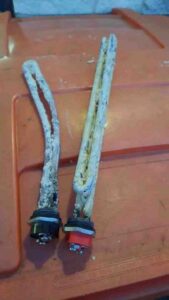
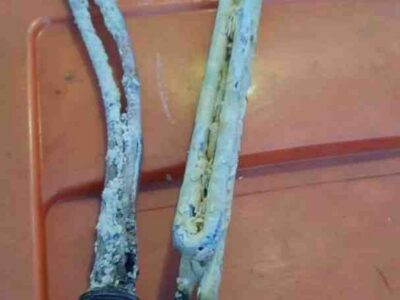
In electric water heaters, this scale coats the upper and lower heating elements. The elements can become encrusted in a jagged, white mineral shell that resembles ocean coral. Because this scale acts as an insulator, the electric elements cannot transfer heat into the water efficiently. The internal temperature of the element rises, causing the metal to fatigue, split, and burn out.
This insulating scale has a direct impact on household energy efficiency:
- Even a thin layer of scale can reduce heating efficiency.
- As scale thickens, the water heater must run longer to heat the same amount of water.
- Heavy scale buildup can lead to repeated element failure, slow recovery, and inconsistent hot water.
- Severe scale can make the system work much harder than it was designed to.
Why Hard Water Can Shorten Water Heater Life
Because of the combined forces of sediment insulation, element burnout, and tank corrosion, water heaters operating in untreated hard water conditions may fail earlier than expected.
Under normal conditions with proper maintenance, many tank-style water heaters are designed to serve a home for years. However, in hard water areas, that service life can be shortened by:
- Sediment buildup at the bottom of the tank.
- Scale forming on electric heating elements or heat transfer surfaces.
- Faster wear on the sacrificial anode rod.
- Corrosion after the anode rod is depleted.
A major contributor to premature failure is the rapid destruction of the anode rod. The anode rod is a sacrificial metal rod, usually made of magnesium or aluminum wrapped around a steel core, suspended inside the tank. Its sole job is to corrode via electrolysis so that the steel tank doesn’t.
In softer water, an anode rod may protect a tank for several years. But in mineral-heavy water, the higher electrical conductivity can accelerate this process. Once the anode rod is completely depleted, your steel tank is left unprotected, leading to rust and pinhole leaks. For more details on how long you can expect your tank to last under these conditions, read Don’t Get Into Hot Water: How Long Your Tank Really Lasts.
Warning Signs Texas Hard Water Is Shortening Your Water Heater’s Life
Your water heater is usually tucked away in a garage, closet, basement, or utility area, making it easy to ignore. However, a struggling water heater will almost always send out clear warning signs that mineral damage is taking its toll. Catching these signs early can help you avoid a stressful plumbing emergency. If you notice any of these indicators, it’s wise to consult the experts; see our guide on 5 Signs You Need a Water Heater Repair Expert.
Performance Problems Homeowners Notice First
The very first clues of hard water damage show up in how your system performs during your daily routine:
- Running Out of Hot Water Quickly: If your morning showers are getting shorter and shorter, sediment buildup may have reduced your tank’s usable capacity.
- Lukewarm Showers: Scale buildup on the heating elements or heat transfer surfaces can prevent the system from reaching its target temperature efficiently, leaving you with lukewarm water.
- Long Recovery Times: If it takes a long time for your water heater to produce hot water again after a shower or a load of laundry, the system may be struggling to push heat through mineral buildup.
- Fluctuating Water Temperatures: Sudden bursts of cold water during a shower can indicate that one heating component is no longer performing properly.
Noises, Water Quality Changes, and Visible Clues
As the mineral buildup becomes more severe, the symptoms become harder to ignore:
- Kettling, Banging, and Popping: If your water heater sounds like a washing machine full of rocks, or if you hear loud popping and cracking noises whenever it turns on, you may be hearing steam bubbles fighting their way through sediment at the bottom of the tank.
- Cloudy or Sandy Water: If your hot water looks cloudy or contains tiny, sand-like white or gray particles, mineral sediment may be breaking loose and entering your hot water lines.
- Rusty or Discolored Water: A red or brown tint in your hot water is a major red flag. It can mean your anode rod has failed and the steel tank itself is rusting from the inside.
- White Crust on Fixtures: If you notice stubborn, white, chalky buildup on sink aerators, showerheads, or around your water heater’s relief valve, it is a clear sign of mineral saturation.
When Repair Stops Making Sense
At Plumbing Outfitters, the goal is always to help Austin-area homeowners choose a safe, practical solution for their home. In some cases, a repair can restore reliable hot water. In other cases, a scale-damaged water heater may be too worn to keep patching.
You should seriously consider replacing your water heater if:
- The unit is older and makes loud, constant rumbling noises that cannot be cleared by flushing.
- You have had to replace the electric heating elements multiple times in the last few years.
- There is any sign of moisture, rust, or active leaking around the base of the tank.
- The system can no longer keep up with your household’s hot water demands.
To help you make this decision, read our guide on Five Signs It’s Time to Replace Your Hot Water Heater.
Tank vs. Tankless Water Heaters in Texas Hard Water Areas
Many Austin and Central Texas homeowners compare traditional tank water heaters with modern tankless systems when planning an upgrade. While tankless systems can offer strong performance and efficient operation, they are not immune to the effects of hard water. In fact, they face a different set of risks. For a complete comparison of these two systems, check out The Great Water Heater Debate: Tankless vs Traditional.
How Hard Water Damages Tank Water Heaters
Traditional tank heaters suffer primarily from sediment accumulation and corrosion. The large volume of standing water inside a 40 or 50-gallon tank allows minerals time to settle out of suspension and form an insulating blanket at the bottom. This can lead to burner strain, damaged glass linings, depleted anode rods, and eventual tank leakage.
How Hard Water Damages Tankless Water Heaters
Tankless water heaters do not store water, so they do not suffer from the same bottom-of-the-tank sediment buildup. Instead, they heat water on demand by forcing it through a network of narrow copper pipes inside a high-powered heat exchanger.
Because tankless systems heat water quickly, mineral precipitation can happen inside these small passages.
- Scale Blockages: Dissolved calcium and magnesium can bake onto the inside of the copper tubing, forming a hard scale lining.
- Restricted Water Flow: As the scale layer thickens, it restricts the flow of water through the unit, leading to a noticeable drop in hot water pressure.
- Heat Exchanger Overheating: The scale acts as an insulator, trapping heat inside the copper heat exchanger walls. This can cause the metal to overheat, fatigue, and crack.
- System Error Codes: Modern tankless units are highly computerized. When scale limits heat transfer or restricts water flow, the system may trigger error codes and shut down to protect the equipment.
- Premature Failure: While tankless systems are designed for long service life, untreated hard water can put serious stress on the heat exchanger if descaling maintenance is neglected.
| Feature / Risk | Traditional Tank Water Heater | Tankless Water Heater |
|---|---|---|
| Primary Damage Mechanism | Bottom sediment buildup and element scale | Heat exchanger scale in narrow passages |
| Common Hard Water Concern | Reduced capacity, corrosion, and slow recovery | Restricted flow, error codes, and heat exchanger stress |
| Common Warning Signs | Rumbling noises, element burnout, capacity loss | Flow restriction, error codes, system shutdowns |
| Required Maintenance | Routine tank flushing and anode rod checks | Routine descaling flush |
Energy Efficiency Impacts for Both Systems
Whether you have a tank or tankless system, hard water scale can affect how efficiently your water heater runs. Mineral scale acts as insulation, making it harder for heat to transfer into the water.
To help slow this mineral precipitation, many homeowners keep the water heater’s thermostat set to 120 degrees F. This temperature is typically comfortable for daily use while helping slow the chemical reaction that causes calcium carbonate to drop out of the water and form scale.
How Texas Homeowners Can Slow Hard Water Damage
While Central Texas geology may be working against your plumbing system, you are not powerless. There are several effective steps you can take to slow down, reduce, and in many cases prevent hard water damage.
Essential Water Heater Maintenance in Hard Water Areas
Regular maintenance is one of the most effective ways to extend the life of an existing water heater. For seasonal tips, see our guide on Top Tips for Spring Water Heater Maintenance.
If you want to protect your system, follow this essential maintenance checklist:
- Flush the Tank Regularly: For standard tank heaters, flushing the system is critical. This involves turning off the power or gas, connecting a garden hose to the drain valve at the bottom of the tank, and running the water until it flows clear of sediment. In homes with very hard water, more frequent flushing may be helpful.
- Descale Tankless Systems Routinely: Tankless systems should be flushed with a descaling solution, such as virgin white vinegar or a manufacturer-approved descaler, using a small pump to dissolve and clear scale buildup inside the heat exchanger.
- Monitor and Replace the Anode Rod: Have a professional inspect your tank’s sacrificial anode rod on a routine basis. Replacing a worn anode rod is a practical way to help keep the tank protected.
- Check the Thermal Expansion Tank: In closed-loop plumbing systems, thermal expansion can cause pressure spikes that stress your water heater’s tank. A functional expansion tank absorbs this pressure and helps reduce tank fatigue.
Why Anode Rod Checks Matter in Texas Hard Water Homes
Because mineral-rich water can accelerate chemical reactions inside your tank, your anode rod may deplete faster than expected.
Checking this sacrificial rod regularly and replacing it once it is mostly consumed helps keep electrolysis focused on the rod rather than the steel walls of your tank.
Water Softeners and Whole-House Filtration Systems
While regular flushing helps manage the symptoms of hard water, installing a water treatment system addresses the root cause of the problem.
A whole-home water softener uses an ion exchange process to remove calcium and magnesium ions from your water, replacing them with sodium or potassium ions depending on the system setup. By reducing these minerals before they reach your water heater, you can greatly limit scale and sediment formation.
This protection can help:
- Support a longer water heater service life.
- Keep your system operating more efficiently.
- Protect other water-using appliances in your home, including dishwashers, washing machines, and plumbing fixtures.
To learn more about how these systems can support your home, explore the 5 Benefits of a Water Softener System for Your Home.
How to Decide If Your Home Needs Water Treatment
If you are tired of dealing with spotty dishes, dry skin, white crust on your fixtures, and water heaters that seem to wear out too soon, you may be a good candidate for a water treatment solution.
A professional water test can show you exactly how hard your water is and help you choose the right system for your household’s needs. If you are wondering if it’s the right choice for you, read our guide on 5 Reasons Why You Are a Candidate for a Water Softener.
Frequently Asked Questions About How Texas Hard Water Affects Water Heater Lifespan
How much shorter is a water heater’s lifespan in hard water?
Untreated hard water can shorten a water heater’s lifespan by contributing to sediment buildup, scale formation, anode rod depletion, and corrosion. The actual impact depends on your home’s water hardness, water usage, maintenance schedule, and equipment condition.
Can flushing remove existing hard water scale?
Flushing is effective at removing loose, sandy sediment from the bottom of a tank water heater. However, once mineral scale has baked onto the heating elements or tank walls, a standard flush may not remove it. For tankless systems, a descaling flush can help dissolve and remove scale from the heat exchanger, provided the equipment has not already been damaged.
Is a water softener enough to protect a water heater?
A properly sized and maintained water softener is one of the best ways to protect your water heater from scale and sediment. By reducing hardness minerals at your home’s point of entry, you limit the buildup that causes many common water heater problems. However, you should still monitor and replace the anode rod as needed to keep the tank protected.
Conclusion
How Texas hard water affects water heater lifespan is a real concern for homeowners across Austin, Round Rock, Cedar Park, Georgetown, Pflugerville, Leander, Hutto, Bastrop, Taylor, Temple, West Lake Hills, and nearby Central Texas communities. Calcium and magnesium in hard water can lead to sediment buildup, insulating scale, reduced efficiency, and premature system wear.
By staying proactive with regular maintenance such as tank flushing, anode rod inspections, and tankless descaling, you can slow down this damage. If you want a more complete solution, a whole-home water softener can help reduce scale before it reaches your water heater and other plumbing fixtures.
Plumbing Outfitters is a locally owned plumbing company serving homeowners throughout the Greater Austin area. Their experienced plumbers handle water heater service, leak detection, plumbing repairs, drain service, full system installations, and water treatment support with a helpful, neighborly approach.
Whether you need a professional system flush, a water softener installation, or a water heater replacement, Plumbing Outfitters is here with helpful guidance, dependable workmanship, and 24/7 availability when urgent issues come up. Contact us today to schedule your Water heater services and protect your home’s plumbing investment!