

The Ultimate Guide to Flushing Your Water Heater
Why Regular Water Heater Maintenance Tips for Homeowners Matter in Central Texas
Water heater maintenance tips for homeowners can mean the difference between a system that lasts well over a decade and one that fails years too soon — and in Central Texas, where hard water from the Edwards Aquifer accelerates sediment buildup, staying on top of this is especially important.
Here is a quick overview of the essential maintenance tasks every homeowner should know:
- Flush the tank at least once a year to remove sediment and mineral deposits
- Test the TPR (temperature and pressure relief) valve annually to confirm it is working safely
- Inspect the anode rod every three years and replace it every three to five years
- Set the thermostat to 120°F to prevent scalding and reduce energy use
- Insulate pipes and the tank to cut standby heat loss
- Schedule a professional inspection once a year to catch issues early
- Flush tankless systems annually (more often in hard water areas) to prevent scale buildup
Your water heater works around the clock, every single day. Most homeowners do not think about it until something goes wrong — a cold shower, a puddle on the floor, or a sudden spike in the energy bill. The problem is that by then, the damage is often already done.
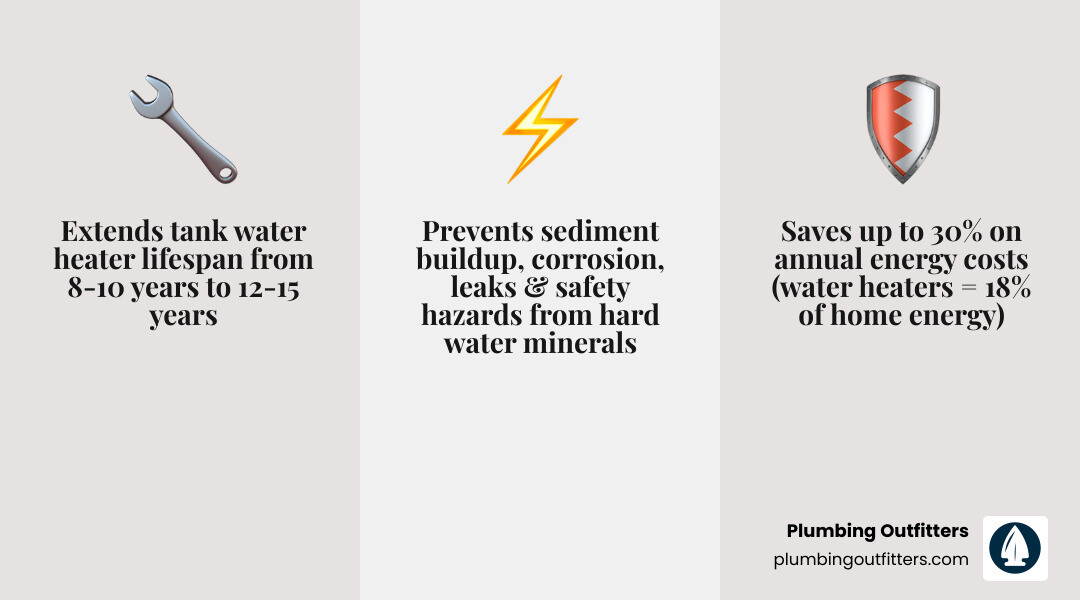
Water heaters account for up to 18% of a home’s total energy expenses, making them one of the biggest energy consumers in the house. Regular maintenance can extend the life of a tank-style unit from the typical 8–10 years up to 12–15 years, and can save you up to 30% on annual energy costs. Neglecting basic upkeep, on the other hand, leads to sediment buildup, corroded components, reduced efficiency, and — in the worst cases — leaks or complete system failure.
Austin’s notoriously hard water makes all of this more urgent. Calcium and limestone deposits build up inside tanks and heat exchangers faster here than in many other parts of the country, which means maintenance schedules that work elsewhere may not be enough for Central Texas homeowners.
The good news is that most water heater maintenance tasks are straightforward, and a consistent routine goes a long way toward protecting your investment.
The Battle Against Central Texas Hard Water
Whether you are in Round Rock, Pflugerville, or downtown Austin, your water likely comes from sources rich in minerals like calcium and magnesium. While these aren’t harmful to your health, they are the arch-nemesis of your plumbing. When water is heated, these minerals solidify into sediment that settles at the bottom of your tank.
This layer of “rock” acts as an insulator between the burner or heating element and the water. Your heater has to work harder and run longer to get the water to the right temperature. This leads to overheating the metal of the tank, which eventually causes it to crack or leak. By extending a water heater’s life through regular care, you avoid the premature “death by sediment” that claims so many units in our area.
| Feature | Well-Maintained Unit | Neglected Unit |
|---|---|---|
| Lifespan (Tank) | 12–15 Years | 6–10 Years |
| Efficiency | High (Low Energy Bills) | Low (High Energy Bills) |
| Water Quality | Clear and Odorless | Rusty or Smelly |
| Repair Frequency | Rare | Frequent |
Step-by-Step Guide: How to Flush Your Tank to Remove Sediment
Flushing your water heater is perhaps the most impactful of all water heater maintenance tips for homeowners. It sounds intimidating, but it is essentially just giving your tank a deep rinse. We recommend doing this at least once a year, though if you live in an area with particularly heavy mineral content, every six months is even better.
Preparation and Safety
Before you start, safety is paramount. You are dealing with high temperatures and either electricity or gas.
- Turn off the power: For electric water heaters, flip the breaker in your electrical panel. For gas heaters, turn the knob on the thermostat to the “Pilot” setting.
- Let it cool: If possible, do this after the heater has been off for a few hours. If you can’t wait, be extremely careful — the water coming out will be scalding.
- Shut off the water: Close the cold water supply valve located at the top of the heater.
The Flushing Process
- Connect a hose: Attach a standard garden hose to the drain valve at the bottom of the tank. Run the other end of the hose to a floor drain, a driveway, or a large bucket.
- Open a hot water tap: Go to a sink inside the house and turn on the hot water. This prevents a vacuum from forming and allows the tank to drain faster.
- Open the drain valve: Slowly open the valve on the water heater. You might hear some gurgling or see “chunky” water coming out at first — that’s the sediment leaving the building!
- The “Rinse” Cycle: Once the tank is empty, briefly turn the cold water supply valve back on at the top of the tank. This will stir up any remaining sediment at the bottom. Keep doing this until the water coming out of the hose is crystal clear.
- Refill the tank: Close the drain valve and remove the hose. Turn the cold water supply back on. Keep that indoor faucet running until the air is bled out of the lines and you have a steady stream of water.
Pro Tip: If you find that not enough hot water is reaching your shower even after a flush, you might have sediment stuck in your aerators or a failing heating element. Also, check out our top tips for spring water heater maintenance for a seasonal checklist to keep your home running smoothly.
Critical Components: Anode Rods and TPR Valves
Beyond the tank itself, there are two small parts that do a massive amount of work: the Anode Rod and the Temperature and Pressure Relief (TPR) valve. Understanding these is vital for any homeowner interested in water heater maintenance tips for homeowners.
The TPR Valve: Your Heater’s Safety Switch
The TPR valve is designed to release water if the pressure or temperature inside the tank gets too high. Without it, a malfunctioning water heater could literally explode.
To test it, place a bucket under the discharge pipe and lift the lever. Water should flow out freely and then stop completely when you release the lever. If it doesn’t flow, or if it keeps dripping after you close it, you need to call us immediately. This is one of the 5 signs you need a water heater repair expert. In Austin, local plumbing standards are strict about these valves for a reason — they save lives.
Essential Water Heater Maintenance Tips for Homeowners: Anode Rods
Think of the anode rod as a “sacrificial lamb.” It is a long metal rod (usually magnesium or aluminum) that hangs inside the tank. Because of a process called electrolysis, the minerals in the water will attack the anode rod instead of attacking the steel walls of your tank.
As the rod “sacrifices” itself, it slowly dissolves. Once the rod is gone, the water starts eating your tank. This leads to rust, leaks, and eventually, the need for a full replacement. We recommend inspecting the rod every three years. If it looks like a chewed-up piece of wire or is covered in thick calcium, it’s time for a new one. Replacing a rod is a fraction of the cost of a new unit, making it one of the best ways to avoid the 5 signs to replace your water heater.
Maximizing Efficiency with Temperature Settings and Insulation
You don’t have to perform a major “operation” on your water heater to save money. Sometimes, the best water heater maintenance tips for homeowners are as simple as turning a dial or adding a “sweater” to your tank.
The Magic Number: 120°F
Most manufacturers ship water heaters with the thermostat set to 140°F. For most households, this is overkill. It increases the risk of scalding and causes your heater to cycle more often, wasting energy.
By turning the dial down to 120°F, you can save up to 5% in energy costs for every 10 degrees you lower the temperature. It also slows down the rate of mineral buildup and corrosion inside the tank. If you are looking for even more ways to save, you might consider energy efficiency tankless water heaters which only heat water when you actually need it.
Insulation: Keeping the Heat In
If your water heater is located in a garage or an unconditioned space in a place like Taylor or Hutto, it is losing heat to the air around it. This is called “standby heat loss.”
- Pipe Insulation: Adding foam pipe sleeves to the first six feet of the hot and cold water pipes can reduce heat loss and prevent pipes from sweating in the summer or freezing during those rare Texas winter snaps.
- Tank Blankets: For older tanks (check your R-value; if it’s less than R-24, you need one), an insulation blanket can reduce standby heat loss by 25%–45%. This is a simple DIY project that pays for itself in just a few months.
Exploring the top benefits of switching to a tankless water heater can also reveal how modern technology eliminates the need for these blankets entirely.
Specialized Care for Modern Systems
Tankless water heaters are becoming incredibly popular in Central Texas, especially in new developments in Leander and Liberty Hill. They are sleek, efficient, and provide endless hot water. However, they are not “maintenance-free.” In fact, because they flash-heat water to high temperatures, they can scale up even faster than tank models.
Tankless Water Heater Maintenance Tips for Homeowners
A tankless unit uses a heat exchanger — a series of small copper pipes — to heat water. If those pipes get coated in scale, the unit will overheat and shut down.
- Annual Descaling: You should flush your tankless system with food-grade white vinegar for at least 45–60 minutes once a year. This dissolves the calcium and keeps the heat exchanger clear.
- Filter Cleaning: Most tankless units have an in-line filter to catch debris from the water main. We recommend checking and cleaning this filter every few months.
If you aren’t comfortable handling the pumps and hoses required for a tankless flush, our tankless water heater services are designed to handle this quickly and cleanly. Understanding the tankless vs. tank water heater differences is key to knowing which maintenance path to follow. We also see many 10 common mistakes in tankless heater installation that can make maintenance harder down the road, so it’s always good to have a professional eye on your setup.
For those living in the city, our Austin tankless water heater experts are well-versed in the specific challenges our local water poses to these high-tech systems.
Frequently Asked Questions and Conclusion
At Plumbing Outfitters, we believe in “Texas Class Service.” That means being a good neighbor and helping you keep your home safe and efficient. Whether you need a simple flush or a complex water heater service, our experienced plumbers are here to help throughout Greater Austin.
How often should I perform water heater maintenance tips for homeowners?
For most homes in Central Texas, an annual flush is the gold standard. However, if you live in an area with extremely hard water (like Georgetown or Round Rock), we suggest a mini-flush every six months. The anode rod should be checked every three years, and the TPR valve should be tested at least once a year. For more specific local advice, check out our guide on Georgetown tank water heater installation and maintenance.
What are the signs my water heater needs professional repair?
While DIY maintenance is great, some things require a pro. If you hear loud rumbling or popping noises (which sounds like popcorn), that is a sign of heavy sediment buildup that might be too thick to flush. Rusty water usually indicates the tank is already corroding. Most importantly, if you see a leak, you need to know what to do when your water heater is leaking immediately to prevent water damage. If you have a modern system, we also specialize in Hutto tankless water heater installation and repair.
How long will a well-maintained water heater last in Austin?
With proper care, a traditional tank water heater can last 12 to 15 years. Without it, you might be looking at a replacement in as little as 6 to 8 years. Tankless units can last 20 years or more if they are descaled regularly. If your unit is nearing the end of its life, you might be wondering how much does replacing a water heater cost? or looking to invest in a new water heater in Taylor, TX.
Don’t wait for a cold shower to tell you there’s a problem. By following these water heater maintenance tips for homeowners, you can enjoy peace of mind and lower bills for years to come. If you ever feel over your head, we are just a phone call away, ready to provide the trustworthy, neighborly service you deserve.