
Why Trenchless Technology Is Changing How Bloomington-Normal Homeowners Handle Sewer Repairs
Understanding how trenchless technology saves your yard and time comes down to one simple idea: your pipes can be repaired or replaced without ever digging a trench across your property. Here’s a quick summary:
How Trenchless Technology Saves Your Yard and Time:
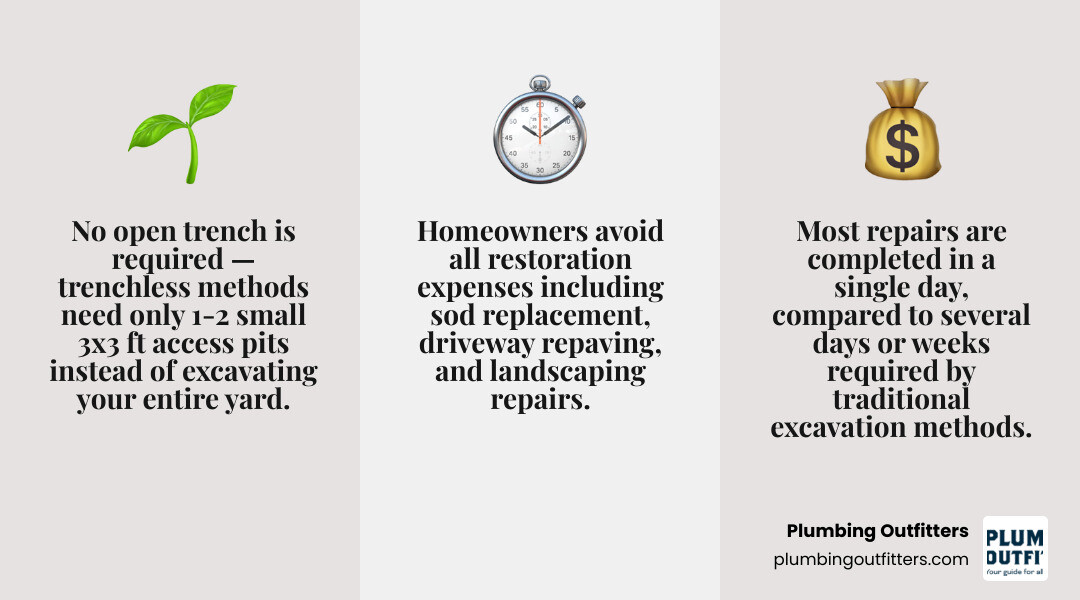
- No open trench — only one or two small access pits are needed
- Yard stays intact — grass, flower beds, driveways, and patios are left undisturbed
- One-day completion — most jobs finish in a single day vs. several days or weeks for traditional excavation
- No restoration costs — you skip sod replacement, driveway repaving, and landscaping repair
- 50-year pipe lifespan — new CIPP liners and HDPE pipes outperform the old clay or cast-iron lines they replace
For most homeowners in Bloomington-Normal, the words “your sewer line needs repair” trigger an immediate and specific fear: a backhoe tearing across the lawn, a muddy trench running from the house to the street, and weeks of disruption before your yard looks anything close to normal again. That picture is understandable — because for a long time, that was the only option available.
Trenchless sewer repair changes that entirely. Instead of excavating the entire pipe run, a trained technician accesses the damaged line through small entry and exit points, then rehabilitates or replaces the pipe from the inside out. The lawn, the driveway, the mature oak tree your family planted twenty years ago — they all stay exactly where they are.
At Plumbing Outfitters, we serve homeowners and businesses across Bloomington, Normal, and the broader Central Illinois region with trenchless solutions that protect your property and get your plumbing back to full function — often within a single day.
What is Trenchless Sewer Repair and How Does It Work?
Trenchless sewer repair is a modern, minimally invasive approach to fixing underground utility lines. Unlike traditional open-cut excavation, which requires heavy machinery to dig up the entire length of the pipe, trenchless methods utilize specialized equipment to restore or replace your lines from the inside out.
Instead of a long, deep trench running through your yard, we only need to dig one or two small access pits (typically about three-by-three feet) at the beginning and end of the pipe run. Through these small entry points, we can insert flexible liners, pull new high-density polyethylene (HDPE) pipes, or patch specific sections of damaged lines.
To understand how this modern method stacks up against older practices, it helps to read our comprehensive comparison of Trenchless vs Traditional Pipe Replacement in Bloomington Normal. To give you a quick overview, we have broken down the primary differences between the two approaches below:
| Feature | Traditional Excavation | Trenchless Technology |
|---|---|---|
| Digging Required | Continuous trench along the entire length of the pipe | Only 1 or 2 small access pits |
| Disruption to Yard | High (destroys grass, gardens, driveways, and sidewalks) | Minimal (leaves surface features untouched) |
| Project Timeline | Several days to weeks (plus weeks of yard restoration) | Typically completed in a single day |
| Restoration Costs | High (sod, concrete, asphalt, and landscaping replacement) | Low to none (only filling the small access pits) |
| Pipe Longevity | Varies by material (often prone to future root intrusion) | 50+ year lifespan (seamless pipes resist root intrusion) |
The Role of Sewer Camera Inspections
Before any physical work begins, we must determine exactly what is happening inside your underground pipes. This is where high-definition sewer camera inspections come in. We feed a flexible, waterproof fiber-optic camera down into your sewer line, allowing us to view the interior of the pipe in real time on a high-resolution monitor.
This diagnostic step is crucial for several reasons:
- Pinpointing the Damage: We can see exactly where cracks, offsets, collapses, or tree root intrusions are located.
- Evaluating Pipe Integrity: The camera helps us assess whether the existing pipe is structurally sound enough for a liner or if it has collapsed completely, requiring a pipe bursting replacement.
- Locating Hidden Connections: We identify any secondary branch lines or utility crossings that we must account for before starting the repair.
- Accurate Project Planning: By knowing the exact depth, material, and condition of the line, we can select the correct trenchless method, ensuring a smooth installation with zero guesswork.
How Trenchless Technology Saves Your Yard and Time
When we talk about how trenchless technology saves your yard and time, we are looking at a complete shift in how property maintenance is handled. In the past, repairing a sewer lateral meant turning your front yard into an active construction zone. Heavy backhoes compact the soil, destroy established root systems, and leave behind a mountain of dirt that takes months to settle.
Trenchless technology eliminates this collateral damage. Because the work happens entirely underground, your lawn, flower beds, and hardscaping remain completely undisturbed. If your sewer line runs directly beneath a paved driveway, a brick patio, or an expensive sidewalk, we do not have to cut through the concrete or asphalt. We simply slide the new pipe or liner underneath the existing structures, saving you from the headache and expense of repaving or rebuilding.
Additionally, this process saves you an immense amount of time. Traditional excavation projects often take several days to repair the pipe, followed by weeks of waiting for landscapers, concrete contractors, and paving crews to restore your property. Trenchless repairs bypass this entire restoration phase, allowing you to return to your normal routine immediately.
Preserving Mature Landscaping and HOA Compliance
For many homeowners in McLean County, a beautiful lawn and mature trees represent years of hard work, care, and financial investment. Traditional trenching often cuts directly through the critical root zones of mature oak, maple, or willow trees, which can weaken or kill the trees over time. Trenchless methods bypass these root systems entirely, keeping your trees healthy and intact.
This level of care is especially beneficial for properties located within Homeowners Associations (HOAs). HOAs in the Bloomington-Normal area often maintain strict guidelines regarding property aesthetics, lawn care, and construction noise. Traditional excavation projects can draw complaints from neighbors and require complex approval processes from HOA boards due to the eyesore of a torn-up yard.
Because trenchless repairs require only small access pits and are typically completed within a single day, they rarely trigger HOA disputes. In many cases, we can complete the entire project without your neighbors even realizing major utility work took place.
Rapid Timelines: How Trenchless Technology Saves Your Yard and Time on Repairs
Time is of the essence when you are dealing with a sewer line failure. Living with limited water usage or a backed-up drain is incredibly stressful.
Here is what a typical timeline looks like when you choose a trenchless solution:
- Morning (Diagnostics & Prep): We arrive on-site, perform a sewer camera inspection, and clean out any debris or tree roots using hydro-jetting.
- Midday (Installation): We set up our trenchless equipment and insert the new pipe liner or execute the pipe bursting process.
- Afternoon (Curing & Testing): If we are using a cured-in-place pipe (CIPP) liner, we cure the resin using heat or UV light. We then perform a final camera inspection to verify that the new pipe is flawless.
- Late Afternoon (Backfill & Cleanup): We fill the small access pits, tidy up the workspace, and restore your water service.
Compare this single-day turnaround to traditional excavation, which can leave your water turned off or restricted for days while crews dig, replace the physical pipe, inspect the trench, backfill the soil, and wait for the ground to settle.
Key Trenchless Methods: CIPP Lining, Pipe Bursting, and Patching
Different pipe problems require different solutions. Depending on the condition of your existing line, we will recommend one of three primary trenchless rehabilitation methods. Each of these methods is designed to restore structural integrity to your utility lines without disturbing your yard.
If you are dealing with water main issues rather than sewer lines, you can learn more about how we handle those systems by reading about our approach to All About Trenchless Water Line Replacement.
Cured-in-Place Pipe (CIPP) Lining
Cured-in-Place Pipe (CIPP) lining is essentially creating a brand-new, seamless pipe inside your old, damaged one. This method is ideal for pipes that are cracked, leaking, or suffering from root intrusion but still retain their overall structural shape.
- The Process: We saturate a flexible felt tube with a high-strength epoxy resin. Using air or water pressure, we blow this liner into the existing pipe, inflating it so it presses tightly against the interior walls.
- The Curing: Once the liner is in place, we circulate hot water, steam, or blue UV light through the tube to activate the resin. This causes the epoxy to harden, creating a smooth, joint-free, and incredibly durable “pipe-within-a-pipe.”
- The Result: Because the new liner is seamless, it eliminates the joints where tree roots typically find their way in. Although it reduces the internal diameter of the pipe by a fraction of an inch, the ultra-smooth interior surface actually improves the overall flow capacity of your sewer system.
Pipe Bursting for Severely Damaged Lines
When an underground pipe has collapsed, is severely misshapen, or needs to be upsized to handle a larger volume of water, CIPP lining is no longer an option. In these cases, we use a method called pipe bursting.
- The Process: We dig two small access pits at either end of the pipe run. We then feed a heavy-duty steel cable through the old pipe and attach it to a cone-shaped steel bursting head.
- The Pull: A powerful hydraulic pulling machine draws the bursting head through the old line. As the cone-shaped head moves forward, it fractures and shatters the old, damaged pipe (such as clay, cast iron, or orangeburg), pushing the broken fragments outward into the surrounding soil.
- The New Pipe: Simultaneously, the bursting head pulls a brand-new, seamless high-density polyethylene (HDPE) pipe directly behind it. Once the pull is complete, you have a completely new, heavy-duty pipe resting in the exact path of the old one.
Sectional Pipe Patching for Spot Repairs
You do not always need to replace an entire sewer line. If your pipe is in great shape overall but has a single localized crack, a small offset joint, or a specific point of root entry, sectional pipe patching is the most efficient choice.
- The Process: We wrap a fiberglass patch saturated with silicate resin around an inflatable packer.
- The Placement: Using our sewer camera to guide us, we push the packer down the line until it is positioned precisely over the damaged section.
- The Cure: We inflate the packer, pressing the resin-soaked patch firmly against the pipe wall. After the resin cures (which typically takes under two hours), we deflate the packer and remove it, leaving behind a smooth, structural patch that seals the leak and prevents future root intrusion.
Long-Term Benefits, Lifespan, and Limitations of No-Dig Repairs
Investing in trenchless technology is not just about saving your lawn today; it is about protecting your home for decades to come. The materials used in modern trenchless repairs—specifically epoxy resins and HDPE pipes—are designed to withstand the harsh freeze-thaw cycles of Central Illinois winters and the shifting clay soils of McLean County.
- 50+ Year Lifespan: Both CIPP liners and HDPE pipes are rated to last 50 years or more, outlasting traditional materials like clay or cast iron.
- Root Resistance: Because trenchless pipes are seamless and joint-free, tree roots cannot find the microscopic gaps they normally use to invade and clog your sewer lines.
- Corrosion-Proof: Unlike old cast-iron pipes, which rust, scale, and eventually weaken from the inside out, modern epoxy and HDPE materials are completely impervious to chemical corrosion and rust.
- Environmental Benefits: Trenchless methods require far less fossil-fuel-powered heavy machinery, generate minimal soil waste, and prevent sewage leaks from contaminating surrounding groundwater.
When Trenchless Methods Are Not Suitable
While we always prefer to use trenchless methods whenever possible, there are certain situations where traditional excavation is still necessary. As honest, neighborly plumbers, we believe in giving you the straight facts rather than pushing a solution that won’t work long-term.
Trenchless methods may not be suitable if:
- The Pipe Has Completely Collapsed: If a pipe is fully flattened or blocked by a complete structural collapse, we cannot pass a camera, a liner, or a bursting cable through it.
- The Pipe Lacks Proper Slope (Backgraded): If your sewer line was poorly installed and “bellies” (sags), causing water to pool, a liner will simply follow the sag. To fix a grading issue, we must physically excavate the line to correct the slope.
- Severe Utility Conflicts: In rare cases where other utility lines (like gas or electrical) were accidentally run directly through or too close to the sewer line, trenchless methods could pose safety risks, requiring a carefully dug traditional trench.
Financing Options for Homeowners
We understand that unexpected sewer line repairs can put a strain on your household budget. Because we believe in delivering a straightforward, neighborly experience, we offer flexible financing options to help you manage the investment.
By taking advantage of our payment plans and financing programs, you can address urgent sewer issues immediately—protecting your home from water damage—while spreading the cost out into manageable monthly payments.
Frequently Asked Questions About Trenchless Sewer Repair
How trenchless technology saves your yard and time compared to digging?
Trenchless technology avoids the massive destruction of traditional excavation by using only one or two small access pits instead of a long, deep trench. This preserves your lawn, flower beds, driveways, and mature trees. Additionally, because we do not have to spend days digging and backfilling, most trenchless projects are completed in a single day, saving you weeks of property restoration.
How long do trenchless pipe repairs actually last?
The materials used in trenchless repairs, such as cured-in-place epoxy liners and high-density polyethylene (HDPE) pipes, are incredibly durable. They are rated to last 50 years or more. These materials do not corrode, rust, or degrade over time, making them a long-term upgrade for your home’s infrastructure.
Can trenchless repair bypass tree root intrusion permanently?
Yes. Tree roots enter sewer lines through the joints and cracks of older clay, concrete, or cast-iron pipes. Because trenchless CIPP lining and pipe bursting create a single, continuous, seamless pipe without any joints, there are no gaps for roots to penetrate. This permanently eliminates root intrusion in the treated section.
Conclusion
Sewer line issues do not have to mean the destruction of your beautifully manicured yard or weeks of chaotic construction noise. By choosing trenchless technology, you can protect your landscaping, keep your driveway intact, and get your home’s plumbing back up and running in a fraction of the time.
At Plumbing Outfitters, we are proud to provide “Texas Class Service” right here in Central Illinois. Our experienced team is dedicated to giving you upfront pricing, honest advice, and dependable, neighborly solutions. Whether you live in Bloomington, Normal, or any of the surrounding McLean County communities, we are here to help you find the smartest, cleanest solution for your home.
If you suspect your sewer line is failing or want to learn more about our advanced piping solutions, explore our repiping and sewer services or contact us today to schedule a professional sewer camera inspection!