

Trenchless vs Traditional Pipe Replacement in Bloomington-Normal
Trenchless vs Traditional Pipe Replacement Comparison: The Core Differences
What Homeowners Need to Know First
When facing a failing sewer line, the trenchless vs traditional pipe replacement comparison is often one of the first decisions homeowners have to make, and the right answer depends on more than just the upfront price.
Here’s a quick breakdown to address that question directly:
| Factor | Trenchless | Traditional Excavation |
|---|---|---|
| Excavation required | Minimal (small access pits) | Full open trench |
| Project timeline | 1-3 days | Several days to weeks |
| Property disruption | Low (lawn, driveway mostly intact) | High (landscaping, concrete often damaged) |
| Pipe lifespan after repair | 50+ years (CIPP or HDPE) | 50-100 years (new pipe) |
| Total cost (all-in) | Often lower when restoration is included | Can run significantly higher with restoration |
| Best for | Cracked, corroded, or root-invaded pipes with intact structure | Collapsed, misaligned, or pipes needing rerouting |
| Works under driveways/slabs | Yes | Requires breaking concrete |
Most homeowners do not discover a sewer problem on a convenient day. It usually starts with a slow drain, a soggy patch in the yard, or an odor that should not be there. Suddenly, you are comparing contractor bids with very different approaches – one involves digging up your yard, while the other promises to fix the pipe from the inside without tearing through your driveway.
Both methods are legitimate. Both have real advantages. And the best choice comes down to your pipe’s condition, where it runs on your property, and what your yard and schedule can handle.
This guide walks through exactly how each method works, what it costs in the big picture, and how to decide which one makes sense for your home.
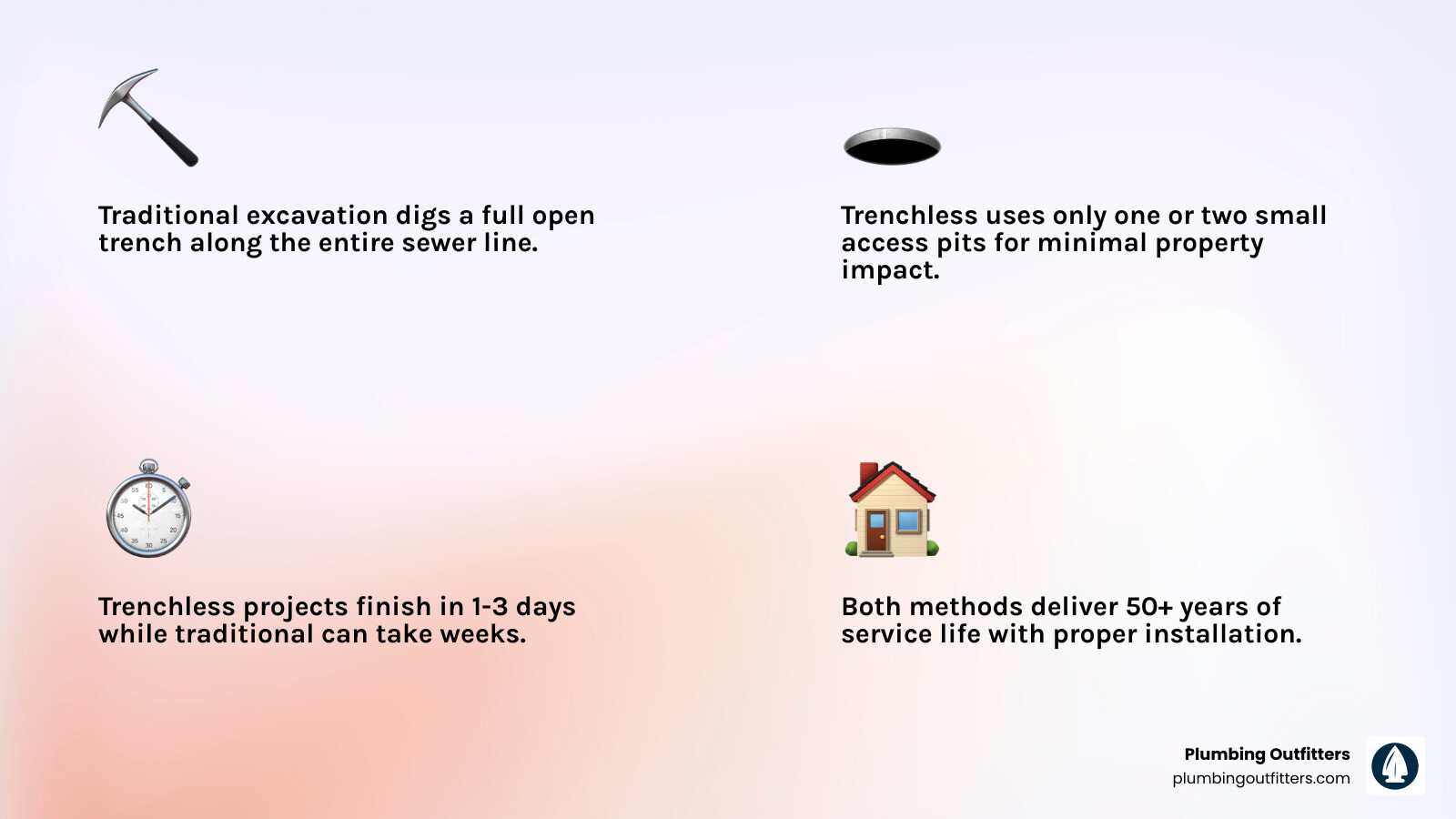
When we talk about a trenchless vs traditional pipe replacement comparison, we are essentially comparing “keyhole surgery” to “open-heart surgery” for your property’s plumbing. For decades, the only way to fix a buried pipe was to find it, dig it up, and swap it out. Today, technology allows plumbers to do much of that work from the inside out.
The primary difference lies in how the pipe is accessed. Traditional excavation requires a continuous trench that follows the entire path of the sewer line. If your pipe is 60 feet long, that often means a 60-foot-long trench. Trenchless methods, on the other hand, typically require only one or two small access pits.
Before recommending either path, a plumber should start with a high-definition camera inspection. This allows the condition of the host pipe, the original pipe buried in your yard, to be evaluated to determine whether it is a good candidate for lining or whether it has structurally failed to the point that digging is necessary.

How trenchless pipe replacement works in existing sewer lines
Trenchless technology generally falls into two categories: Cured-In-Place Pipe (CIPP) lining and pipe bursting.
- CIPP Lining: The existing pipe is cleaned thoroughly to remove roots and debris. Then, a flexible, epoxy-saturated liner is inserted into the pipe. Using air pressure, the liner is inverted so the epoxy presses against the old pipe walls. Once it cures, it forms a brand-new, jointless pipe inside the old one.
- Pipe Bursting: This is used when a brand-new pipe is needed rather than a liner. A heavy, cone-shaped bursting head is pulled through the old line. As it moves, it breaks the old pipe apart and pushes the fragments into the surrounding soil while simultaneously pulling a brand-new HDPE (high-density polyethylene) pipe into place behind it.
Both methods focus on a minimal surface footprint, making it possible to work under driveway crossings and slab areas without the need for large-scale demolition.
How traditional excavation replaces a damaged line
Traditional excavation is exactly what it sounds like. Heavy machinery is used to dig a continuous trench, exposing the damaged line from start to finish. The old segments, whether clay, cast iron, or old PVC, are then removed and replaced with new piping.
Once the new line is in place and inspected, the trench is backfilled with soil. However, the process does not end there. Because the soil has been disturbed, it needs to be graded, and the surface, whether it was a lawn, patio, sidewalk, or driveway, must be restored. That restoration is often one of the most labor-intensive and time-consuming parts of the project.
Cost, Time, and Disruption: What Homeowners Notice Most
In any trenchless vs traditional pipe replacement comparison, the most immediate impacts on a homeowner are how long the water will be off and how much of the yard will be missing when we’re done.
While the upfront plumbing labor for trenchless can sometimes appear higher on a line-item bid, the “hidden costs” of traditional digging often flip the script. When you factor in the cost of a new driveway, professional landscaping, and the time spent dealing with a torn-up property, trenchless often saves homeowners 30% to 50% on the total project cost.
trenchless vs traditional pipe replacement comparison for timelines and downtime
Time is of the essence when your sewer is out of commission.
- Trenchless: Most projects are completed in 1-3 days. The actual “curing” window for a liner might take several hours, but the preparation and final inspection are swift.
- Traditional: These projects can stretch from several days to multiple weeks. The digging alone takes time, but the restoration phase—waiting for concrete to pour, sod to take root, or fences to be reinstalled—can leave your home feeling like a construction zone for a long time.
If you are curious about the broader scope of pipe work timelines, you can read more about How Long Does a Repipe Take? What Homeowners Should Know.
trenchless vs traditional pipe replacement comparison for property damage
This is where the comparison becomes very visual. Traditional digging doesn’t care if your prize-winning roses or your custom-stamped patio are in the way; the trench must go where the pipe goes. This can lead to significant damage to:
- Mature trees (root systems are often severed)
- Hardscaping and patios
- Driveways and sidewalks
- Foundations (if the pipe runs too close)
Trenchless methods preserve these features. Because we are working underground through small access points, your lawn stays mostly intact, and your driveway remains drivable. For many homeowners in the Greater Austin area, preserving the curb appeal of a well-maintained property is the deciding factor.
Durability, Lifespan, and Performance After the Repair
A common question we hear is whether a “liner” is just a temporary fix. The reality is that modern trenchless materials are engineered for the long haul. CIPP liners and HDPE pipes used in bursting are often warrantied for 50 years and can realistically last much longer.
Are trenchless liners as durable as newly installed pipe?
Yes. In many ways, a trenchless liner can be superior to traditional sectional pipe. Because the liner is jointless, it eliminates the very thing that causes most sewer failures: joints. Tree roots naturally seek out moisture and enter pipes through the tiny gaps in joints. A seamless epoxy liner gives them nowhere to enter.
Furthermore, the smooth interior of a CIPP liner can actually improve flow capacity, even though the diameter of the pipe is technically reduced by a few millimeters. The lack of friction from old, corroded cast iron or rough clay makes for a much more efficient system.
When long-term performance favors a full dig-and-replace
Despite the wonders of technology, there are times when a full dig-and-replace is the only responsible choice. We typically recommend traditional excavation if:
- The pipe has fully collapsed: If there isn’t enough of a “tunnel” left for a liner or a bursting head to pass through, we have to dig.
- Severe Grade Issues (Bellies): If your pipe has a “belly” (a sagging section where water pools), a liner will simply follow that sag. To fix the pitch of the pipe so it drains correctly by gravity, we must excavate and regrade the soil.
- Major Misalignment: If the pipe sections have shifted so far apart that they no longer line up, a trenchless solution may not be able to bridge the gap.
In these cases, a full system redesign ensures your plumbing meets modern code updates and performs reliably for the next century. For more on making this choice in older properties, check out our guide on Old House Plumbing Problems: Should You Repair or Replace?.
When Trenchless Is Best and When Traditional Is the Better Choice
Every property in the Greater Austin area is unique. Some have wide-open yards with easy access, while others in denser neighborhoods have pipes buried deep under concrete or near structural foundations.
Best situations for trenchless pipe replacement in Greater Austin
Trenchless is almost always the “Plan A” for:
- Pipes under driveways or patios: Saving the cost of concrete demolition and replacement is a massive win.
- Lines near foundations: Digging a deep trench right next to a foundation can be risky; trenchless avoids this vibration and soil displacement.
- Root intrusion: If your host pipe is structurally sound but keeps getting clogged by roots, a liner is a permanent “keep out” sign for those trees.
- Shorter downtime: If you can’t afford to have your water off for more than a day, trenchless is the way to go.
When traditional excavation is the smarter or only practical option
Traditional digging becomes the preferred route when:
- Rerouting is needed: If you are planning an addition to your home and need to move the sewer line, you’re already digging.
- Shallow, open runs: If the pipe is only two feet deep in an open grass field with no landscaping, the cost of excavation might actually be lower than the specialized equipment needed for trenchless.
- Collapsed sections: As mentioned, a pipe that has lost its structural shape cannot be lined effectively.
Sometimes, we even suggest a “hybrid” repair—digging up a small, collapsed section and then lining the rest of the healthy pipe to save the remainder of the yard.
Environmental, Safety, and Local Decision Tips for Central Texas Homeowners
In the Greater Austin area, we deal with specific soil conditions—largely expansive clay soils that shift and move with seasonal moisture changes. This movement is hard on pipes, especially older clay and cast iron.
How trenchless and traditional methods affect the environment and jobsite safety
The trenchless vs traditional pipe replacement comparison also includes an environmental and safety component.
- Waste Reduction: Trenchless creates significantly less waste. We aren’t hauling away tons of old dirt and broken pipe, nor are we bringing in as much new backfill.
- Safety: Open trenches are inherently hazardous. They pose risks of cave-ins and are a danger to pets and children if not perfectly secured. Trenchless projects minimize these “open-hole” risks significantly.
- Fuel Use: Fewer heavy machines running for fewer days means a smaller carbon footprint for your home project.
How to choose the right pipe replacement method for your property
Deciding on a method shouldn’t be a guessing game. Here is our recommended checklist:
- Request a CCTV Inspection: Never agree to a sewer replacement without seeing the footage yourself.
- Get a Written Report: The plumber should explain exactly where the cracks, offsets, or collapses are.
- Map the Line: Know exactly where the pipe runs. Is it under your favorite oak tree? Under the garage floor?
- Compare All-In Costs: If you get a traditional bid, ask the contractor if it includes repaving the driveway and replanting the grass. Often, it doesn’t.
If you are concerned about the financial side of things, our article on How Much Does Residential Repiping Cost? provides a great framework for understanding plumbing investments.
Frequently Asked Questions About Trenchless vs Traditional Pipe Replacement Comparison
Is trenchless always the better option for sewer line replacement?
Not always. While it is less disruptive, it requires the original pipe to have enough structural integrity to hold the liner. If the pipe is “pancaked” or has a severe belly that causes constant backups, traditional excavation is necessary to fix the physical path of the water.
Can trenchless pipe replacement be used under a driveway or foundation area?
Yes! This is actually where trenchless technology shines brightest. By using existing cleanouts or small access pits outside the concrete zone, we can rehabilitate the pipe without ever swinging a jackhammer inside your garage or across your driveway.
How do I know if my pipe can be lined instead of excavated?
The only way to know for sure is a professional camera evaluation. If the camera can pass through the pipe and we see that the walls are still round (even if they are cracked or have roots), lining is usually an option. If the camera hits a wall of dirt or a crushed section, we’ll need to talk about excavation.
Conclusion
At Plumbing Outfitters, we believe in providing Texas Class Service—which means being honest, upfront, and neighborly. Whether you choose a trenchless solution to save your landscaping or a traditional replacement to fix a collapsed line, our goal is to ensure you never have to worry about that pipe again.
The trenchless vs traditional pipe replacement comparison isn’t about which technology is “cooler”—it’s about which one protects your property and your wallet over the next 50 years. If you’re smelling something off in the yard or your drains are acting up, don’t wait for a full collapse.
More info about repiping services is available if you want to explore how we handle these projects from start to finish. Let us help you make an informed decision that keeps your Greater Austin home running smoothly for decades to come.