
How to Prevent Gas Leaks and Keep Your Home Safe
Why Gas Piping Safety Tips for Homeowners Can Save Lives
Gas piping safety tips for homeowners are something every household needs to know — not just once, but as an ongoing habit. Natural gas powers the furnaces, water heaters, stoves, and fireplaces in millions of homes across the country. It’s efficient, reliable, and cost-effective. But when something goes wrong with a gas line, the consequences can be severe — including fires, explosions, and carbon monoxide poisoning.
Here’s a quick overview of the most important gas safety steps every homeowner should follow:
- Know the signs of a gas leak – smell of rotten eggs, hissing sounds, dead vegetation, or unexplained dizziness
- Evacuate immediately if you suspect a leak — leave doors open, avoid electronics, and call 911 from outside
- Locate your main gas shutoff valve before an emergency happens so you can act fast
- Schedule annual professional inspections of your gas lines and appliances
- Install carbon monoxide detectors on every level of your home, especially near bedrooms
- Never attempt DIY gas repairs — it’s dangerous and illegal in most jurisdictions
- Call 811 before any digging project to prevent accidental line strikes
Consider this: a homeowner in Portland once noticed a faint sulfur smell near their furnace. What seemed like a minor nuisance turned out to be a corroded connector on the verge of failure. A licensed technician caught it early, replaced the fitting, pressure-tested the line, and restored service the same day — preventing what could have been a much more dangerous situation.
Gas systems operate under precise pressure and run through some of the most vulnerable areas of your home — basements, crawl spaces, and behind walls. That’s why staying informed and proactive is so important.

Recognizing the Warning Signs of a Gas Leak

Natural gas is naturally colorless and odorless. To make it detectable, utility companies add a chemical called mercaptan, which gives it that unmistakable “rotten egg” or sulfur-like scent. This is your primary defense against a disaster, but it isn’t the only sign you should be looking for.
In the Greater Austin area, where we experience shifting soil and occasional extreme weather, gas lines can be stressed in ways you might not expect. Being vigilant means using all your senses. If you suspect an issue, we recommend reviewing these five signs you have a gas leak to help you identify the problem quickly.
Beyond the smell, keep an eye out for:
- Dead or discolored vegetation: If you notice a patch of dead grass or plants in your yard that follows the path of your underground gas line, it’s a major red flag. Escaping gas displaces the oxygen in the soil, effectively suffocating the plants from the roots up.
- Physical symptoms: Prolonged exposure to low levels of natural gas can cause headaches, dizziness, fatigue, nausea, and eye or throat irritation. If these symptoms improve when you leave the house, you likely have a leak.
- High utility bills: An unexplained spike in your monthly gas bill often indicates that gas is escaping somewhere in your system, even if the leak is too small to smell initially.
Essential gas piping safety tips for homeowners: Smell and Sound
While the “rotten egg” smell is the most famous indicator, sound is just as critical. A hissing or whistling sound near a gas appliance, connection, or line is a sign of high-pressure gas escaping. In some cases, you might even see physical evidence of a leak, such as:
- Bubbling water: If you see bubbles in standing water or puddles in your yard, gas may be leaking from an underground pipe.
- White dust or clouds: A leak in a buried line can sometimes blow dirt or create a “white cloud” effect near the ground.
- Whistling pipes: Whistling sounds near the meter or appliance connectors often indicate a loose fitting or a crack in the line.
Proactive gas piping safety tips for homeowners
As we move through April 2026, it is important to remember that many homes in communities like Round Rock, Pflugerville, and Cedar Park were built during the housing booms of the late 1990s and early 2000s. This means many residential gas systems are reaching that 20-to-30-year mark where corrosion and wear become significant risks.
The best way to prevent an emergency is to stay ahead of it. We recommend scheduling a professional inspection at least once a year. During these visits, a licensed plumber will check for corrosion, test line pressure, and ensure that all appliance connectors are secure. If you are planning an upgrade or moving into a new home, understanding the 5 Reasons to Hire a Plumber for Gas Pipe Installation is a great place to start. For our neighbors in East Austin, our team provides specialized Bastrop/Gas Piping Installation Maintenance Repair Replacement/ services to keep local systems running safely.
Why DIY work violates gas piping safety tips for homeowners
We know the “do-it-yourself” spirit is strong in Texas, but gas piping is one area where you must put down the wrench and call in the pros. Attempting to repair or install gas lines yourself is not only dangerous—it’s often illegal.
- Explosion and Fire Risks: A single tiny leak caused by an improperly tightened fitting can fill a room with gas, waiting for a single spark from a light switch or refrigerator motor to ignite.
- Carbon Monoxide Danger: Improperly vented appliances or poorly connected lines can lead to incomplete combustion, releasing deadly carbon monoxide into your living spaces.
- Insurance and Legal Issues: Most homeowners’ insurance policies will not cover damages caused by unpermitted or unlicensed gas work. Furthermore, local codes in cities like Austin and Georgetown require licensed professionals to pull permits and perform pressure tests for any gas line modifications.
Protecting your family with carbon monoxide detectors
While natural gas leaks are a threat, carbon monoxide (CO) is often called the “silent killer” because it is completely odorless, colorless, and tasteless. It is a byproduct of gas that doesn’t burn completely.
To keep your family safe:
- Install detectors on every level: Place them near sleeping areas and in the basement.
- Test monthly: Use the test button to ensure the alarm is functioning.
- Replace batteries annually: Even if the detector is hardwired, the backup battery needs to be fresh.
- Know the lifespan: Most CO detectors last 5–7 years. If yours is older than that, replace it immediately.
Severe CO exposure can be fatal within hours. If your alarm goes off, treat it with the same urgency as a fire or a gas leak.
Emergency Response and Shutoff Procedures
If you smell gas or suspect a leak, your first priority is safety—not investigation. Do not try to find the leak yourself.
Follow these immediate steps:
- Evacuate everyone: Get all people and pets out of the house immediately.
- Leave the door open: This helps ventilate the space as you exit.
- Avoid electronics: Do NOT turn lights on or off, use a telephone inside, or even start your car if it’s in an attached garage. Any electrical arc can trigger an explosion.
- Call from a safe distance: Once you are at least 100 feet away, call 911 or your local gas utility provider.
For residents dealing with an active concern, our Services/Gas Leak Detection And Repair/ team is available to respond quickly and secure your home.
How to safely operate your main gas shutoff valve
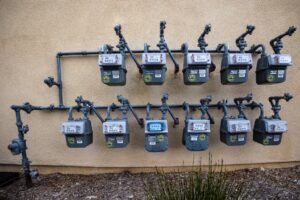
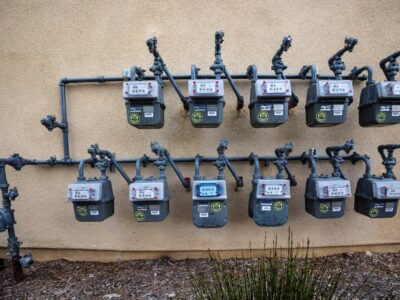
Every adult in your home should know where the main gas shutoff valve is located and how to use it. Usually, this valve is located outside your home near the gas meter.
The valve itself is typically a rectangular nub on the pipe. When the valve is “on,” the nub is parallel to the pipe. To turn it off, you will likely need a large wrench. Turn the valve a quarter turn in either direction so that it sits perpendicular (at a 90-degree angle) to the pipe.
Note: Once you turn the gas off at the meter, do not turn it back on yourself. Only a licensed plumber or a utility representative should restore service after performing a safety check and pressure test.
Preventing Corrosion and Excavation Damage
Corrosion is one of the leading causes of gas leaks in older homes. Most traditional gas lines are made of black iron or steel, which can rust over time, especially in the humid or damp conditions found in crawl spaces.
In the Greater Austin area, our soil is known for its high clay content, which expands and contracts significantly with our weather cycles. This “soil shifting” can put immense stress on underground pipes, leading to cracks or loose fittings. We provide targeted support for these issues through our Hutto/Hutto Gas Piping Installation And Repair/ and Taylor/Gas Piping Installation Maintenance Repair And Replacement/ services, ensuring that your underground infrastructure is as solid as the lines inside your walls.
Safe digging practices for home improvement
Did you know that excavation damage is the leading cause of unplanned utility outages? Whether you are planting a tree in Leander or installing a new fence in Pflugerville, you must Call 811 at least two to three business days before you start digging.
This free service coordinates with utility companies to mark the location of underground gas, water, and electric lines. Striking a gas line with a shovel or backhoe isn’t just a nuisance—it’s a life-threatening emergency that can lead to immediate evacuations for your entire neighborhood.
Understanding Your Home’s Gas System Components
Knowing what’s in your walls can help you spot trouble early. Most modern residential systems use a combination of rigid and flexible piping.
| Feature | Black Iron Pipe | CSST (Corrugated Stainless Steel Tubing) |
|---|---|---|
| Material | Uncoated Steel | Flexible Stainless Steel |
| Durability | Extremely strong, heat resistant | Resistant to corrosion, flexible |
| Installation | Requires threading and heavy tools | Easier to snake through walls |
| Best For | Main supply lines and headers | Branch lines to appliances |
| Safety Note | Prone to rust if not maintained | Must be properly bonded/grounded |
We help homeowners in the northern suburbs navigate these systems with our Georgetown/Gas Piping/ and Granger/Gas Piping Repair And Replacement/ expert services.
Installing new gas appliances safely
When you buy a new gas range or a high-efficiency water heater, the installation is about more than just “hooking it up.” Each appliance has specific BTU (British Thermal Unit) requirements. If your existing gas line is too small to handle the load of a new, larger appliance, it can cause the pilot lights on other appliances to go out or lead to poor performance.
Proper ventilation is also key. Furnaces and water heaters must be vented to the exterior to prevent CO buildup. If you are adding a new gas feature to your home, check our Category/Gas Piping/ section for more tips on safe appliance integration.
Frequently Asked Questions about Gas Safety
How often should I have my gas lines inspected?
We recommend a professional inspection every 1 to 2 years. If your home is more than 20 years old, or if you have recently experienced significant soil shifting or local construction, an annual check is the safest bet. Regular maintenance allows us to catch minor corrosion or loose fittings before they become emergencies.
What should I do if I smell gas but can’t find a leak?
If you smell that “rotten egg” odor, do not go looking for the leak. Even if you can’t see or hear anything, the presence of the odor means gas is present in the air. Evacuate the premises immediately and call for professional help from a safe location. It is better to have a “false alarm” than to risk an explosion.
Can I use white Teflon tape on gas pipe threads?
No. Never use standard white Teflon tape (which is designed for water lines) on gas piping. Gas molecules are smaller and can leak through the thinner white tape. You must use yellow gas-rated Teflon tape, which is much denser and specifically designed to create a chemical-resistant seal for natural gas and propane.
Conclusion
At Plumbing Outfitters, we believe that your home should be a sanctuary, and that starts with safety. Whether you are in Austin, Round Rock, or any of our surrounding communities, we are committed to providing “Texas Class Service” for all your gas piping needs.
From emergency leak detection to the installation of new, high-efficiency gas lines, our neighborly and experienced team is here to ensure your system meets the highest safety standards of April 2026. Don’t wait for a “rotten egg” smell to take action. Protect your home and family by scheduling a comprehensive safety check with our experts today.
For professional assistance you can trust, visit our Services/Gas Piping/ page and let us help you keep your home running safely and efficiently.