

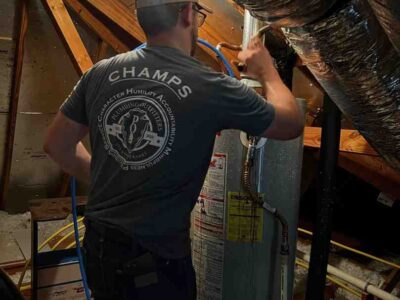
How to Decide Between Water Heater Repair and Replacement
Understanding Your Water Heater’s Lifespan and Age
How to decide between water heater repair and replacement comes down to four key factors: the age of your unit, the cost of the repair, the condition of the tank, and how efficiently it still meets your household’s hot water needs.
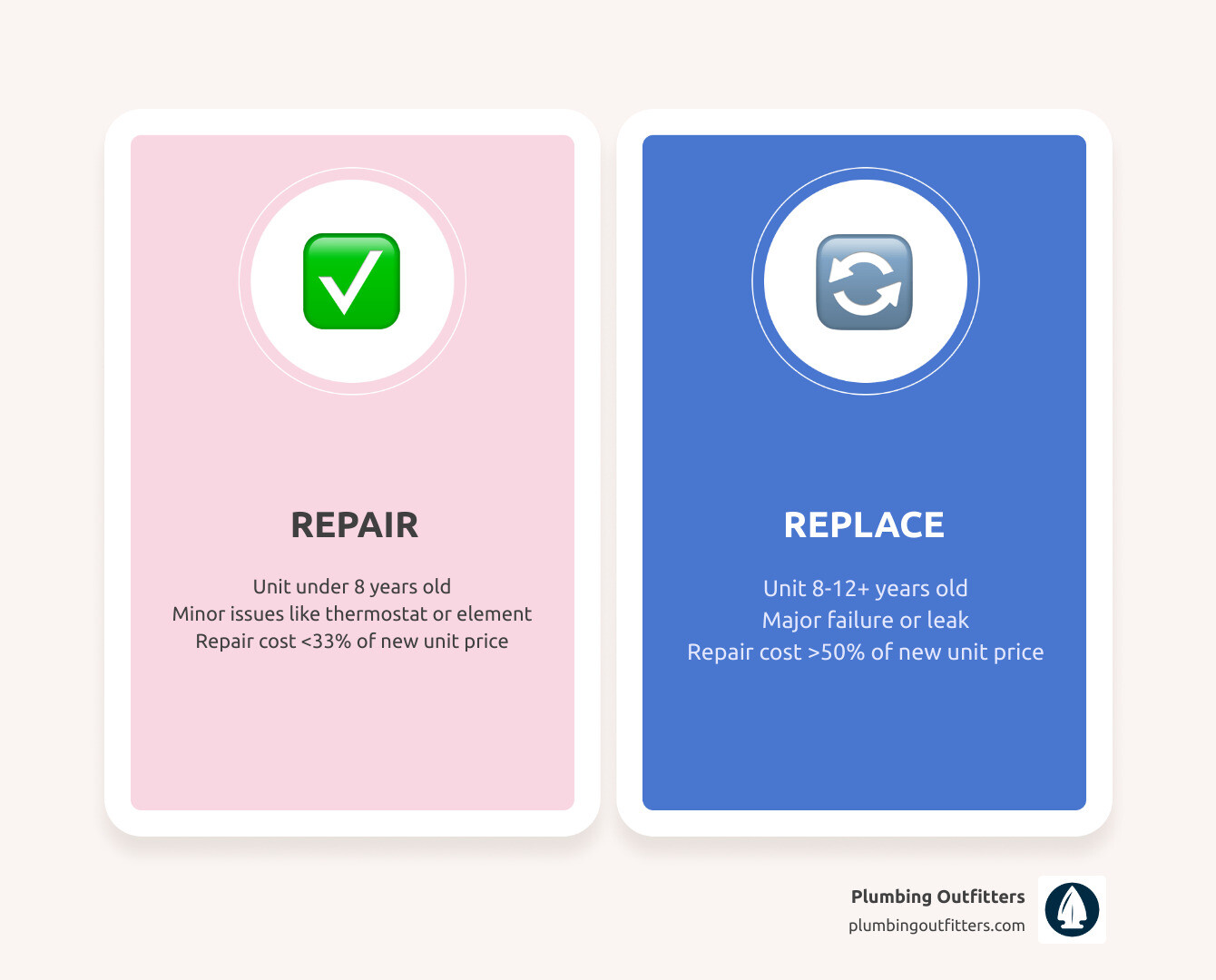
Here is a quick-reference guide to help you decide:
| Situation | Recommended Action |
|---|---|
| Unit is under 8 years old, minor issue (thermostat, element) | Repair |
| Repair cost is less than 33% of a new unit’s price | Repair |
| Unit is 8-12 years old with a major component failure | Lean toward replacement |
| Repair cost exceeds 50% of a new unit’s price | Replace |
| Tank is leaking from the base or body | Replace immediately |
| Visible rust, internal corrosion, or persistent odors | Replace |
| Unit is over 10 years old with repeated breakdowns | Replace |
| You need greater capacity or better energy efficiency | Replace and upgrade |
Most homeowners never think about their water heater until something goes wrong — and then the decision has to happen fast, often under pressure. The average tank-style water heater lasts somewhere between 8 and 12 years. Once it starts showing signs of trouble, especially past the 10-year mark, every repair dollar you spend is a gamble on borrowed time.
The good news is that this does not have to be a stressful guessing game. A clear framework — based on age, repair costs, tank condition, and energy efficiency — makes the decision straightforward. Whether you are dealing with lukewarm showers, strange rumbling noises, or a puddle forming at the base of your unit, this guide walks you through exactly what to look for and what to do next.

Before we can roll up our sleeves, we need to know exactly what we’re working with. As of May 2026, many homeowners in the Greater Austin area are finding that units installed around 2014 to 2016 are reaching their natural “retirement age.”
A standard tank water heater typically has a life expectancy of 8 to 12 years. If you have a tankless model, you’re in luck—those can often last 15 to 20 years or more with proper care. However, these are just averages. Factors like local water hardness (which we see plenty of in Central Texas) and maintenance history can shorten or extend these windows.
If you aren’t sure how old your unit is, look for the manufacturer’s nameplate on the side of the tank. This plate contains the model and serial number, along with data like the working pressure and insulation R-value. The manufacture date is usually hidden within the serial number. For example, a serial number starting with “0522” might indicate the unit was built in May 2022. If it’s not obvious, a quick web search of the brand and serial number will usually clear it up. Knowing this date is the first step in 5 Signs to Replace Your Water Heater.
How to decide between water heater repair and replacement based on unit age
When we look at a unit that is 10 years old or older, we have to be realistic. Even if a repair seems minor, the internal components are likely wearing thin. If your heater is in that 8-12 year “danger zone,” we often recommend replacement, especially if the repair involves major components like the gas valve or a cracked burner assembly.
Investing in a repair for a 12-year-old tank is like putting brand-new tires on a car with a failing engine—it might look like a fix, but you’re likely only buying yourself another 18 months of service before the whole system fails.
Repair vs. Replacement: Using the 50% Rule for Water Heaters
In the plumbing world, we use a simple financial filter called the “50% Rule.” If the cost of the repair exceeds 50% of the cost of a brand-new unit, replacement is almost always the smarter investment. This is especially true if the unit is past the halfway point of its expected lifespan.
Another factor to weigh is the warranty status. Most water heaters come with a 6-year or 10-year warranty on the tank. If your unit is still under warranty, repair is almost always the way to go because the manufacturer may cover the cost of parts. However, once that warranty expires, you are on the hook for every service call. If you’ve had more than one repair in the last 12 months, it’s a sign that the system is “piling up” issues, and it’s time to look at How Much Does Replacing a Water Heater Cost?
Evaluating the cost-benefit of modern efficiency
Replacing a failing 10-year-old water heater isn’t just an expense; it can actually be a way to save. Modern high-efficiency models can cut your water heating costs by 20% to 30% annually. Water heating typically accounts for about 13% of a home’s energy use, so these savings add up quickly.
Older tanks suffer from “standby heat loss,” where the unit constantly works to keep 50 gallons of water hot even when no one is home. Newer units have better insulation (higher R-values) and faster recovery rates, meaning they use less energy to get your water back to temperature after a long shower.
Red Flags That Make Replacement Non-Negotiable
Sometimes, the choice is taken out of your hands. There are certain “red flags” where repair isn’t just expensive—it’s impossible or unsafe. If you notice moisture pooling around the base of the tank or see rust streaks running down the side, you are likely looking at internal corrosion. You can learn more about these warning signs in our guide on What to Do When Your Water Heater is Leaking.
How to decide between water heater repair and replacement when the tank leaks
If the tank body itself is leaking, the unit is finished. There is no reliable way to “patch” a corroded water heater tank. The structural integrity of the metal has been compromised, and a small drip today can become a catastrophic flood tomorrow. To protect your home from water damage, we recommend immediate Water Heater Replacement in Austin, TX whenever a tank-body leak is detected.
Safety risks and gas-related hazards
Safety is our top priority. For gas-powered heaters, there are non-negotiable risks:
- Carbon Monoxide: If your unit isn’t venting properly, it can release odorless, deadly gas into your home.
- Gas Odors: A persistent “rotten egg” smell near the unit indicates a gas leak, which requires immediate professional attention.
- Stacking: This occurs in gas units when short, frequent uses of hot water cause the burner to cycle rapidly, heating the water in the top of the tank to dangerously high temperatures.
- Pilot Light Failures: If your pilot light won’t stay lit despite cleaning, it could indicate a faulty thermocouple or a more serious ventilation issue.
Troubleshooting Common Issues: When to Call a Pro
Not every problem requires a new unit. Some issues are localized and can be fixed with a quick part swap. If you’re experiencing fluctuating temperatures or a total lack of hot water, it might be a fixable component failure rather than a dead tank.
Identifying fixable component failures
For electric models, we often use a multimeter to test the heating elements for continuity. If an element has burned out, replacing it is a straightforward repair. Similarly, a faulty thermostat or a broken thermocouple on a gas unit are common “small problems” that don’t require a full replacement. We always check these components first to see if we can save you the cost of a new installation. You can find more diagnostic tips in our article on 5 Signs You Need a Water Heater Repair Expert.
Addressing water quality and noise
Do you hear rumbling, popping, or banging noises? This is usually the sound of hardened sediment at the bottom of the tank. As water bubbles up through the sediment layer, it creates those “mini-explosions.” In many cases, a professional flush can clear this out and restore quiet operation.
However, if your water is discolored (rusty) or smells like sulfur, it may be a sign that your anode rod has failed and the tank is beginning to corrode from the inside out. For more details on these specific Austin-area issues, check out our Water Heater Repair Austin Guide 2025.
Upgrading for Efficiency and Household Demand
If you’ve decided on replacement, you have a golden opportunity to upgrade. Your household’s needs might have changed since the last heater was installed. Maybe your family has grown, or you’ve added a high-flow rain showerhead that your old 40-gallon tank just can’t keep up with.
Choosing the right technology for your home
This is the perfect time to explore the Tankless vs Tank Water Heater: What’s the Difference? debate.
- Tankless Heaters: These provide endless hot water on demand and can last over 20 years. They also save space, as they are wall-mounted units.
- Heat Pump (Hybrid) Heaters: These are incredibly efficient, using electricity to move heat from the air into the water. They can be 2-3 times more efficient than standard electric models.
- Traditional Tanks: Still the most popular choice for their low upfront cost and simplicity.
Upgrading to a more efficient system is a major selling point and can significantly increase your property value. We dive deeper into these choices in The Great Water Heater Debate: Tankless vs Traditional.
Maintenance Steps to Extend Your Unit’s Life
The best way to avoid the “repair vs. replace” headache is proactive maintenance. You can significantly extend the 8-12 year average lifespan by following a few simple steps.
Proactive care for long-term reliability
- Annual Flushing: We recommend flushing your tank every 6 to 12 months to remove sediment and limescale. This keeps the heating elements efficient and prevents the “rumbling” that leads to tank fatigue.
- Anode Rod Replacement: The anode rod is a “sacrificial” piece of metal that attracts corrosion so the tank doesn’t have to. Replacing it every 3 to 5 years can double the life of your tank.
- Pressure Check: Ensure your home’s water pressure is between 40 and 60 psi. High pressure (above 80 psi) puts immense stress on the tank’s seams and connections.
- T&P Valve Test: Periodically testing the Temperature and Pressure Relief valve ensures that if the tank ever overheats, it can safely vent the pressure.
For a full checklist, visit our guide on Extending a Water Heater’s Life and look for the Five Signs It’s Time to Replace Your Hot Water Heater to stay ahead of any issues.
Frequently Asked Questions about Water Heater Decisions
Is a leaking water heater always a sign for replacement?
Not always, but you have to find the source. If the leak is coming from a loose connection, a faulty T&P valve, or a drain valve, we can usually fix it. If the leak is coming from the bottom of the tank or through the insulation, it’s a sign of internal corrosion and the unit must be replaced.
How do I find the manufacture date on my water heater?
Check the serial number on the manufacturer’s label. The first few digits usually represent the month and year. If you’re unsure, you can enter the brand and serial number into a manufacturer’s “warranty lookup” tool online to find the exact age.
What is the average lifespan of a tankless water heater?
Tankless water heaters typically last 15 to 20 years, and some can even reach 25 years with regular descaling and maintenance. This is nearly double the lifespan of a traditional tank model.
Conclusion
Deciding how to decide between water heater repair and replacement doesn’t have to be a “polar bear plunge” into the unknown. By looking at the age of your unit, applying the 50% rule, and checking for non-repairable red flags like tank leaks, you can make a choice that protects both your comfort and your wallet.
At Plumbing Outfitters, we are proud to provide “Texas Class Service” to our neighbors throughout Greater Austin, including Round Rock, Cedar Park, Pflugerville, and Leander. Whether you need a quick heating element swap or a full high-efficiency upgrade, our experienced plumbers provide upfront pricing and trustworthy advice. We are here to ensure you never have to worry about a cold shower again.
Schedule your water heater service today with Plumbing Outfitters and experience the peace of mind that comes with professional, neighborly care.