

Don’t Get Into Hot Water: How Often to Service Your Tank
Determining How Often Should You Service Your Water Heater
When we talk to our neighbors in Greater Austin about their home maintenance, the water heater is often the most overlooked appliance. However, staying on top of a schedule is vital for your home’s comfort. Most manufacturers recommend that both tank and tankless units receive professional attention at least once a year. This isn’t just a suggestion; it is often a requirement to keep your manufacturer’s warranty in good standing.
If you skip these visits, you risk more than just a cold shower. Neglect leads to sediment buildup, which acts as an insulator, forcing your heater to work harder and driving up your monthly utility bills. For more information on how we can help keep your system running smoothly, check out our water heater services.
| Water Heater Type | Professional Service Interval | Recommended Flushing Frequency |
|---|---|---|
| Standard Tank (Gas/Electric) | Annually | Every 6 to 12 months |
| Tankless | Every 1 to 2 years | Annually (Descaling) |
| Hybrid / Heat Pump | Annually | Every 12 months |
Service frequency for standard tank units
Storage tanks are the workhorses of Central Texas homes, but they are prone to sediment accumulation. As minerals settle at the bottom of the tank, they can cause the unit to overheat or create “popping” sounds. We recommend a full professional inspection once a year to check the electrical components or gas burners and ensure the tank’s integrity. If you have a traditional unit, our team specializes in tank water heater services to help you avoid premature failure.
How often should you service your water heater if it is tankless?
Tankless units are loved for their efficiency and “endless” hot water, but they aren’t maintenance-free. Instead of a large tank of water, they use a heat exchanger with small passages. Over time, calcium and magnesium (common in our local water) create a hard scale that restricts flow and reduces efficiency. To prevent this, a professional descaling procedure should be performed every 12 to 24 months. You can learn more about caring for these modern systems on our tankless water heater service page.
Key Factors Influencing Your Maintenance Schedule

While the “once a year” rule is a great baseline, several factors can move your timeline up. If you have a large family in Round Rock or Pflugerville using hot water for back-to-back showers and multiple loads of laundry daily, your components will wear out faster. Similarly, the age of your unit matters; a system over seven years old needs more frequent “check-ups” than a brand-new one. For a seasonal perspective, take a look at our top tips for spring water heater maintenance.
The impact of hard water in Greater Austin
In areas like Georgetown, Cedar Park, and Liberty Hill, water hardness is a major concern. “Hard” water contains high levels of dissolved minerals. When this water is heated, the minerals solidify into limescale. This scale coats the heating elements and the anode rod, accelerating corrosion. In these conditions, we often recommend flushing the tank every six months rather than once a year. Proactive care is the best way to focus on extending a water heater’s life.
Usage patterns and household size
A home with two occupants puts significantly less strain on a water heater than a household of five or six. High demand means the burners or elements are firing more often, and more water is flowing through the system, bringing more minerals with it. If you find yourself consistently running out of hot water, it might be a sign that your usage has outpaced your maintenance or even the size of your unit. If that sounds familiar, this guide on insufficient hot water can offer some clarity.
Essential Tasks During a Professional Service Visit

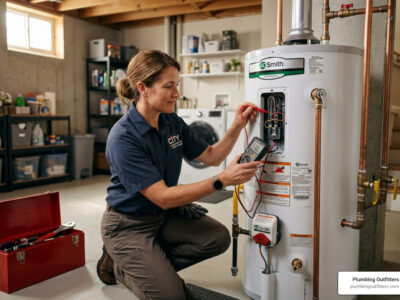
When we visit your home for a service call, we do much more than just look at the tank. A professional visit is a comprehensive safety and efficiency audit. We check the Temperature and Pressure Relief (TPR) valve to ensure it isn’t stuck; if this valve fails and pressure builds up, the results can be dangerous. We also inspect gas lines for leaks, check electrical connections for signs of scorching, and verify the thermostat is set to a safe 120°F. If you haven’t had an expert look at your system lately, here are 5 signs you need a water heater repair expert.
Why you should flush your water heater every six months
Flushing is the process of draining the tank to remove the “sludge” or sediment at the bottom. This simple task can save you between 8% and 34% on your energy bills, according to the U.S. Department of Energy. Here is how a standard flush works:
- Turn off the power (electric) or set the gas to “Pilot.”
- Close the cold water inlet valve.
- Attach a garden hose to the drain valve at the bottom.
- Open a hot water faucet elsewhere in the house to break the vacuum.
- Open the drain valve and let the water flow until it runs clear (usually 20-25 minutes).
- Briefly turn the cold water back on to “stir up” remaining sediment.
- Close the drain valve, refill the tank, and then restore power.
Inspecting the sacrificial anode rod
The anode rod is a “unsung hero” inside your tank. It is a long metal rod made of magnesium or aluminum that is designed to corrode so your steel tank doesn’t have to. Over time, the rod is eaten away entirely. Once it’s gone, the water begins attacking the tank itself, leading to rust and eventual leaks. We recommend checking the rod every 2 to 3 years—or every year if you use a water softener, as softened water can actually speed up anode depletion. Knowing when to swap this rod can prevent you from seeing the signs it’s time to replace your hot water heater.
Recognizing Signs You Need Service Sooner Than Planned
Even with a schedule, your water heater might “tell” you it needs help between visits. If you turn on the tap and see tea-colored or rusty water, your tank or anode rod is likely corroding. If you hear banging, rumbling, or popping sounds coming from the closet or garage, that’s the sound of steam bubbles struggling to move through a thick layer of sediment. If you see any pooling water around the base, you should immediately learn what to do when your water heater is leaking to prevent structural damage.
Warning signs for gas and electric models
Gas and electric units have different “red flags.” For gas heaters, a pilot light that keeps going out often indicates a dirty thermocouple or a clogged air intake. For electric models, if you suddenly have lukewarm water instead of hot, one of the two heating elements has likely burned out. In either case, ignoring these issues can lead to a total system shutdown. If you’re seeing these problems frequently, it might be one of the 5 signs to replace your water heater entirely.
Consequences of neglecting regular maintenance
The cost of neglect is far higher than the cost of a service visit. Beyond high energy bills, the most common consequence is a tank rupture. A standard 50-gallon tank that bursts can cause thousands of dollars in water damage to flooring and drywall in minutes. Furthermore, most insurance companies and manufacturers will deny claims if there is no record of professional maintenance. If you are facing a replacement because of neglect, make sure you know what you need to know about gas water heater replacement.
Frequently Asked Questions about Water Heater Care
How often should you service your water heater in hard water areas?
In the Greater Austin area, where mineral content is high, we recommend a “mini-flush” every six months and a professional inspection every year. This prevents the sediment from hardening into a “scale” that is much harder to remove later.
Can I perform water heater maintenance myself?
Homeowners can certainly handle basic flushing and thermostat adjustments. However, tasks like testing the TPR valve, inspecting gas burners, or replacing a corroded anode rod involve safety risks. It is always safer to have a licensed plumber handle the technical inspections to ensure everything is up to code. If you’re worried about the long-term budget, understanding how much replacing a water heater costs often highlights why spending a little on maintenance now is the smarter financial move.
What is the typical lifespan of a water heater in 2026?
As of April 2026, a well-maintained tank-style water heater typically lasts 10 to 12 years. Tankless units can last 20 years or more with regular descaling. Hybrid or heat pump units fall somewhere in the middle, often reaching 13 to 15 years if the air filters are kept clean.
Conclusion
At Plumbing Outfitters, we believe that “Texas Class Service” means being a good neighbor and helping you protect your home. Whether you are in Round Rock, Georgetown, or Austin, your water heater is the heart of your home’s comfort. Don’t wait for a leak or a cold morning to realize your system needs attention. Our experienced team is available 24/7 to handle everything from routine flushes to emergency repairs with upfront pricing and a neighborly touch.
Schedule your professional water heater service today and keep the hot water flowing for years to come!