
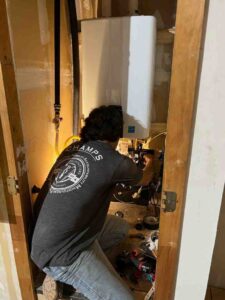

Don’t Get Into Hot Water: How Long Your Tank Really Lasts
Is Your Water Heater Living on Borrowed Time in Texas?
How long does a water heater last in Texas is one of the most common questions homeowners ask — and the honest answer is: shorter than you might expect. In most Texas homes, a traditional tank water heater lasts somewhere between 8 and 12 years. But thanks to the state’s notoriously hard water, scorching summers, and occasional deep freezes, many units don’t even make it that far.
Here’s a quick look at what you can realistically expect:
| Water Heater Type | Typical Lifespan in Texas |
|---|---|
| Gas Tank | 6–12 years |
| Electric Tank | 8–12 years |
| Tankless (Gas or Electric) | 15–20 years |
| Heat Pump (Hybrid) | 13–15 years |
Most people don’t think about their water heater until the morning their shower goes cold halfway through — or worse, they walk into a puddle. By then, the damage is already done. The good news is that knowing what shortens a water heater’s life in Texas puts you ahead of most homeowners. With the right maintenance habits and a clear sense of when to repair versus replace, you can get every possible year out of your unit — and avoid a cold surprise.
In this guide, we’ll cover everything you need to know: how Texas conditions affect your water heater, the warning signs to watch for, maintenance that actually makes a difference, and how to decide when it’s time for a new one.

Understanding How Long a Water Heater Lasts in Texas

When we talk about the longevity of home appliances, the “average” can be a bit misleading. In a perfect world, a water heater might purr along for fifteen years without a hitch. However, we live in Texas, and our appliances have to work a lot harder than those in milder climates.
The type of fuel your unit uses also plays a role in its survival. Generally, electric tank models may last a year or two longer than gas models because they don’t deal with the corrosive byproducts of combustion. However, regardless of the fuel source, the tank itself is usually the “Achilles’ heel.” Once a tank begins to corrode from the inside out, there is no repairing it — only replacing it.
If you’re curious about the fundamental differences in how these systems operate and how those differences impact your home, check out our guide on Tankless vs. Tank Water Heater: What’s the Difference?
How long does a water heater last in Texas compared to the national average?
Nationally, the average lifespan for a tank-style water heater is often cited as 10 to 15 years. In Texas, and specifically in areas around Austin and Dallas-Fort Worth, that number drops significantly. Many homeowners in our region find that their gas units begin to fail between the 6- and 9-year mark.
Why the discrepancy? It comes down to a “triple threat” of local conditions: high mineral content in the water, extreme ambient temperatures in garages and attics where units are often stored, and high demand from larger households. In Central Texas, we often see units reach the end of their reliable life two to three years sooner than the national average.
Lifespan differences between tank and tankless models
If you are tired of the 10-year replacement cycle, tankless models are a compelling alternative. Because they heat water on demand rather than keeping a massive tank of water hot 24/7, they undergo much less structural stress.
A well-maintained Tankless Water Heater Austin TX can easily last 15 to 20 years, with some high-end models reaching 25 years. They are essentially the “marathon runners” of the plumbing world. While they still require maintenance—specifically descaling to handle our hard water—they don’t have a giant steel tank that can rust through and flood your home.
Why Texas Water Quality and Climate Impact Longevity
In Texas, your water heater isn’t just fighting time; it’s fighting the very water it holds. Most of our water in Central Texas comes from sources like the Edwards Aquifer, which is rich in limestone and minerals. While this water is safe to drink, it is “hard” on your plumbing.
How long does a water heater last in Texas with hard water?
Hard water is arguably the #1 killer of water heaters in cities like Round Rock, Georgetown, and Austin. When water is heated, minerals like calcium and magnesium solidify and settle at the bottom of the tank. This creates a thick layer of “scale.”
Once that scale builds up, it acts like a layer of insulation between the heating element (or burner) and the water. This forces the unit to run longer and hotter to reach the desired temperature, which eventually overheats the metal tank and leads to cracks. If your water hardness is above the 120 ppm threshold—which is common across Central Texas—your unit’s life could be cut short by 2 to 4 years if you don’t take action. For those sticking with traditional units, a Tank Water Heater Austin TX requires diligent flushing to combat this.
The effect of extreme Texas heat and freezes on your unit
We all remember the 2021 freeze, but even our standard summer heat plays a role. In Texas, many water heaters are located in attics or garages. During a typical July, an attic can reach 140°F or higher. This high ambient temperature increases the internal pressure of the tank, causing the metal to expand and contract more aggressively.
On the flip side, winter freezes can cause pipes leading to the unit to burst if they aren’t properly insulated. Following Top Tips for Spring Water Heater Maintenance can help you assess any damage from the previous season and prepare for the heat ahead.
Warning Signs Your Unit is Nearing the End of Its Life
Your water heater will usually try to tell you it’s failing before it finally gives up the ghost. Learning to “listen” to your plumbing can save you from a major flood.
- Inconsistent Temperatures: If your morning shower starts hot but turns lukewarm after five minutes, sediment buildup is likely taking up space in the tank, leaving less room for hot water.
- Rusty Water: If you see a reddish or brown tint in your hot water (but not the cold), it’s a sign that the inside of your tank is actively corroding.
- Strange Noises: If your heater sounds like it’s making popcorn, that’s the sound of steam bubbles exploding through a thick layer of sediment at the bottom of the tank.
For a deeper dive into these red flags, read our article on Five Signs It’s Time to Replace Your Hot Water Heater.
Decoding your water heater age using the serial number
Don’t know how old your unit is? You don’t need a receipt; you just need the serial number on the manufacturer’s label. While every brand is a little different, many use a simple date code.
For example, a serial number starting with “0422” often means the unit was manufactured in April 2022. Others use letters for months (A for January, B for February, etc.). If you see a “C16,” it likely means March 2016. Knowing the age is the first step in Appliance age identification and helps you decide if a repair is worth the investment.
When a leak means a total system failure
Not all leaks are created equal. If you see water dripping from a pipe connection or the pressure relief valve, we might be able to simply tighten a fitting or replace a valve.
However, if you see water pooling at the very base of the tank or seeping through the insulation jacket, the tank has likely developed an internal crack. Because these tanks are a single bonded unit, they cannot be welded or patched. If the tank is leaking, it’s a total system failure. If you find yourself in this situation, here is What to Do When Your Water Heater is Leaking.
Maintenance Strategies to Extend Your Unit’s Longevity
The difference between a water heater that lasts 8 years and one that lasts 15 years is almost always maintenance. In Texas, “install and forget” is a recipe for early failure.
- Annual Flush: Draining the tank once a year removes the “scale” and sediment that causes overheating.
- Temperature Check: Setting your heater to 120°F (the DOE recommendation) reduces the rate of mineral buildup and saves energy.
- Visual Inspection: Every few months, just look at the unit for signs of “crusty” buildup on the valves.
For more detailed tips, see our guide on Extending a Water Heater’s Life.
The importance of the sacrificial anode rod
Inside every tank water heater is a “sacrificial” anode rod, usually made of magnesium or aluminum. Its sole job is to be more attractive to corrosion than the steel tank itself. The minerals in the water attack the rod instead of the tank walls.
Think of it as a lightning rod for rust. Over 3 to 4 years, this rod will eventually dissolve. Once it’s gone, the minerals start eating your tank. Replacing this rod every few years is one of the cheapest ways to double the life of your Tank Water Heater Category unit.
Flushing sediment to prevent “popcorn” noises
That “popping” or “rumbling” sound isn’t a ghost; it’s sediment. As minerals settle, they trap a small amount of water against the bottom of the tank. When the burner turns on, that trapped water boils instantly, creating a miniature explosion through the sediment layer.
By performing a regular flush, you remove this “blanket” of minerals. This not only quiets the unit but also improves the “recovery rate”—how fast your heater can get more hot water ready after a shower. If you’ve noticed Not Enough Hot Water? This Can Help you understand why flushing is non-negotiable in Texas.
Repair vs. Replace: Making the Right Choice for Your Home
When a water heater starts acting up, the big question is: do I fix it or trash it?
We generally recommend the 50% Rule: If the cost of the repair is more than half the cost of a new unit, and the unit is over 8 years old, replacement is usually the smarter financial move. Investing a lot of money into a 10-year-old tank that could spring a leak next month is often “throwing good money after bad.” If you’re unsure, consulting 5 Signs You Need a Water Heater Repair Expert can provide clarity.
When to invest in a new water heater in 2026
As of 2026, water heater technology has advanced significantly. Newer models are far more insulated and efficient than those built just a decade ago. If your current unit is nearing the end of its life, you might consider:
- Hybrid Heat Pump Models: These are incredibly energy-efficient and can pay for themselves in utility savings over a few years.
- Smart Tech Integration: Many modern units now feature leak detection sensors that can shut off your water automatically and send an alert to your phone.
- High-Efficiency Gas: If you prefer gas, modern venting and burner technology offer much faster recovery times.
When considering a Gas Water Heater Replacement: What You Need to Know, always look at the long-term energy savings, not just the initial sticker price.
Frequently Asked Questions
Can a water heater last 20 years in Texas?
A traditional tank-style water heater rarely lasts 20 years in Texas due to our hard water and heat. However, a high-quality tankless unit can easily reach the 20-year mark if it is descaled annually.
Does a water softener help a water heater last longer?
Absolutely. A water softener removes the calcium and magnesium that cause scale buildup. By feeding “soft” water into your heater, you eliminate the #1 cause of tank failure in Texas, potentially adding 2 to 4 years to the unit’s lifespan.
Why do electric water heaters sometimes last longer than gas?
Electric units don’t have a gas burner at the bottom, which creates “hot spots” that can accelerate tank fatigue. They also don’t have a flue running through the center of the tank, which is another common point for corrosion to start.
Conclusion
At Plumbing Outfitters, we’ve seen thousands of water heaters across Greater Austin, from Hutto and Taylor to Round Rock and West Lake Hills. We know exactly what the Texas climate does to these systems, and we’re here to help you navigate the choice between a quick repair and a long-term upgrade.
Whether you need a routine flush to keep your current tank going or you’re ready to switch to a high-efficiency tankless system, we provide “Texas Class Service” that is neighborly, transparent, and built on trust. Don’t wait for a cold shower to find out your unit is failing. Schedule your professional Water Heater Services today and let us ensure your home stays in hot water—the good kind!