

Why PEX Piping Installation is Revolutionizing Home Plumbing
PEX piping installation is a modern plumbing solution that’s making life easier for homeowners across Austin, TX. If you’re wondering how to install PEX piping, here’s the quick answer:
Basic PEX Installation Steps:
- Cut PEX tubing squarely with a proper PEX cutter
- Slide a crimp ring or clamp onto the pipe
- Insert the fitting fully into the tubing
- Position the ring 1/8″ to 1/4″ from the pipe end
- Crimp or clamp the connection using the appropriate tool
- Verify with a go/no-go gauge to ensure a proper seal
- Support the tubing every 32 inches horizontally
If you’re dealing with old, corroded pipes or planning a bathroom renovation, PEX offers a faster, more affordable alternative to traditional copper. This flexible, cross-linked polyethylene tubing resists corrosion, handles freeze-thaw cycles better than rigid pipes, and costs about one-third the price of copper. Whether you’re tackling a small repair or considering a whole-home repipe, understanding PEX installation can save you time and money.
The beauty of PEX lies in its simplicity. Unlike copper, which requires soldering skills and open flames, PEX connections use mechanical fittings that snap together with basic tools. As one installation manual puts it, PEX is “ideal for retro-fit applications” because its flexibility lets you snake it through walls without tearing out half your drywall. For professional help with your plumbing project, schedule a consultation with Plumbing Outfitters today.
Introduction: What is PEX and Why is it a Game-Changer?
PEX, short for cross-linked polyethylene, is nothing short of a plumbing revolution. We’re talking about the biggest advancement since the flush toilet! This flexible plastic tubing has been a staple in European homes for decades, with thousands of leak-free PEX systems now over 30 years old. It’s no wonder it’s rapidly becoming the go-to choice for homeowners and plumbers across the U.S.
So, what exactly makes PEX so “PEX-cellent”? Let’s explore its advantages over traditional plumbing materials like copper and CPVC:
Advantages Over Copper:
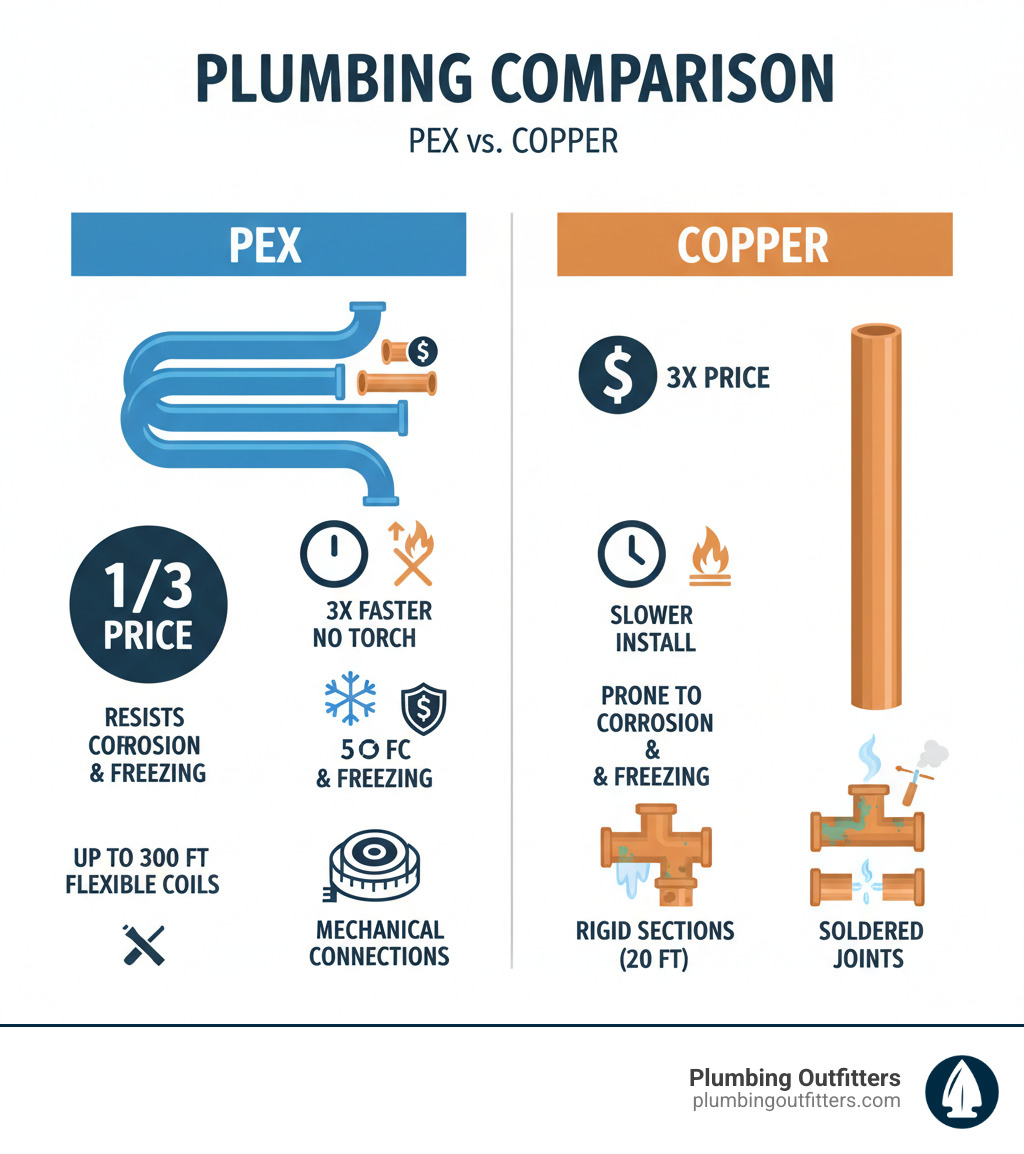
- Cost Savings: This is a big one. PEX piping costs less than half the price of copper. For example, half-inch PEX tubing costs about one-third the price of copper. This difference can add up significantly on a larger project.
- Faster Installation: PEX installs much faster than copper. Why? No more sweating pipes with a torch! PEX uses mechanical connections, which means no soldering, no open flames, and a greatly reduced risk of house fires.
- Flexibility: PEX is incredibly flexible, making it a dream for navigating tight spaces and snaking through walls without extensive demolition. Imagine trying to bend a copper pipe around a corner – PEX just curves right along! It has a strong “memory,” always wanting to spring back to its original shape.
- Corrosion Resistance: Unlike copper, PEX won’t corrode, pit, or develop pinhole leaks, especially in areas with acidic water. This means cleaner water and a longer lifespan for your plumbing system.
- Quieter Operation: PEX’s flexibility and material properties help to absorb pressure surges, reducing the annoying “water hammer” noise often associated with rigid copper pipes.
Advantages Over CPVC:
- Freeze Resistance: PEX pipe is significantly less likely than CPVC pipe to burst if it freezes. PEX tubing can expand several times its original size without damage when frozen, saving you from costly repairs if a cold snap hits unexpectedly. While freeze protection is always recommended, PEX offers an extra layer of resilience.
- No Glues or Solvents: CPVC requires messy and sometimes toxic glues for connections, which need proper ventilation and curing time. PEX uses mechanical connections, eliminating the need for these chemicals.
- Greater Flexibility: Similar to copper, PEX is far more flexible than rigid CPVC, making it easier and faster to install, especially in retrofitting situations.
Versatility for Hot and Cold Water:
PEX tubing is certified for both hot and cold potable water distribution systems, as well as hydronic radiant heating systems. You’ll often see it color-coded (red for hot, blue for cold, and white for either) to help with identification during installation. It can even be used in continuously recirculating plumbing systems up to 140°F while maintaining excellent chlorine resistance.
The bottom line? PEX offers durability, cost-effectiveness, and ease of installation that makes it a logical choice for modern plumbing.
Gearing Up: Planning Your PEX Project
Before you grab your tools and dive into PEX piping installation, let’s talk strategy. A little planning now saves headaches (and leaks!) later. Think of this as your pre-game warmup – getting everything lined up so the actual installation flows smoothly.
Choosing Your PEX Tubing and System Design
Here’s where things get interesting: not all PEX tubing is created equal. You’ve got three main players in the game – PEX-A, PEX-B, and PEX-C – and while they’re all excellent choices, each has its own personality.
PEX-A is the flexible superstar of the bunch. Made using the Engel (peroxide) method, it bends easier than the others and has this cool “shape memory” trick. If you accidentally kink it (hey, it happens!), you can often fix it with a heat gun, and it’ll bounce right back to its original shape. PEX-A works primarily with expansion fittings, which we’ll talk about in a minute.
PEX-B hits that sweet spot between flexibility and affordability. Manufactured using the silane (moisture-cure) method, it’s slightly stiffer than PEX-A but still wonderfully easy to work with. It offers excellent burst resistance and works great with crimp and cinch clamp fittings. For many homeowners tackling a PEX piping installation, PEX-B is the go-to choice.
PEX-C is the stiffest of the trio, created through an electron-beam process. Don’t let “stiffest” fool you, though – it’s still way more flexible than copper or CPVC. It also uses crimp and cinch clamp connections and gets the job done reliably.
For most residential water lines, all three types are reliable and code-compliant. The choice often comes down to what fitting system you prefer and your budget.
Now, about those colors: You’ll see PEX in red, blue, and white. This isn’t just for looks – red is for hot water, blue is for cold water, and white works for either. This simple color-coding makes life so much easier when you’re identifying lines during installation or tracking down a problem years down the road.
Designing Your System
You’ve got two main approaches to laying out your PEX plumbing, and they’re quite different from each other.
The trunk and branch system works like traditional copper plumbing. A main supply line (the trunk) runs through your home, and smaller lines (branches) split off to individual fixtures. This method uses more fittings but can be simpler if you’re working with existing plumbing.
The manifold system (also called a home-run system) is where PEX really shows off. Picture a central manifold – kind of like an electrical breaker box for your water – that sends a dedicated PEX line directly to each fixture. Fewer fittings hidden in walls means fewer potential leak points. Plus, you often get faster hot water delivery, and shutting off water to one fixture for repairs becomes incredibly easy.
Picking Your Fittings
PEX fittings come in two main flavors: brass and poly alloy (polyphenylsulfone or PPSU).
Brass fittings are the traditional choice – robust, durable, and lead-free (containing 0.25% lead or less). They work with crimp, cinch, and expansion systems, and they’re widely accepted by building codes everywhere.
Poly alloy fittings are made from high-performance plastics that resist corrosion beautifully. They’re lightweight and code-approved, making them a smart choice if you have aggressive water that might affect brass. Just remember: while poly alloy insert fittings are excellent, avoid plastic threaded fittings for connections to metal threaded fittings. Different expansion rates and the risk of cross-threading make that combination a recipe for trouble.
A Word About Local Codes
Here’s the deal: there’s no single national plumbing code that covers everywhere. Before you start your PEX piping installation, always check with your local plumbing inspector. For detailed technical specifications, you can also consult resources like the PEX Plumbing Design Guide from the Plastics Pipe Institute. What’s perfectly fine in one part of Austin might have specific requirements in another area. If you’re uncertain about local regulations or want to ensure everything’s done right, our team at Plumbing Outfitters is always happy to help guide you through the process.
Essential Tools and Connection Methods
One of PEX’s biggest advantages? No torch required! But you’ll still need a few specialized tools to get the job done right. Think of these as your plumbing superpowers.
Your PEX Toolkit
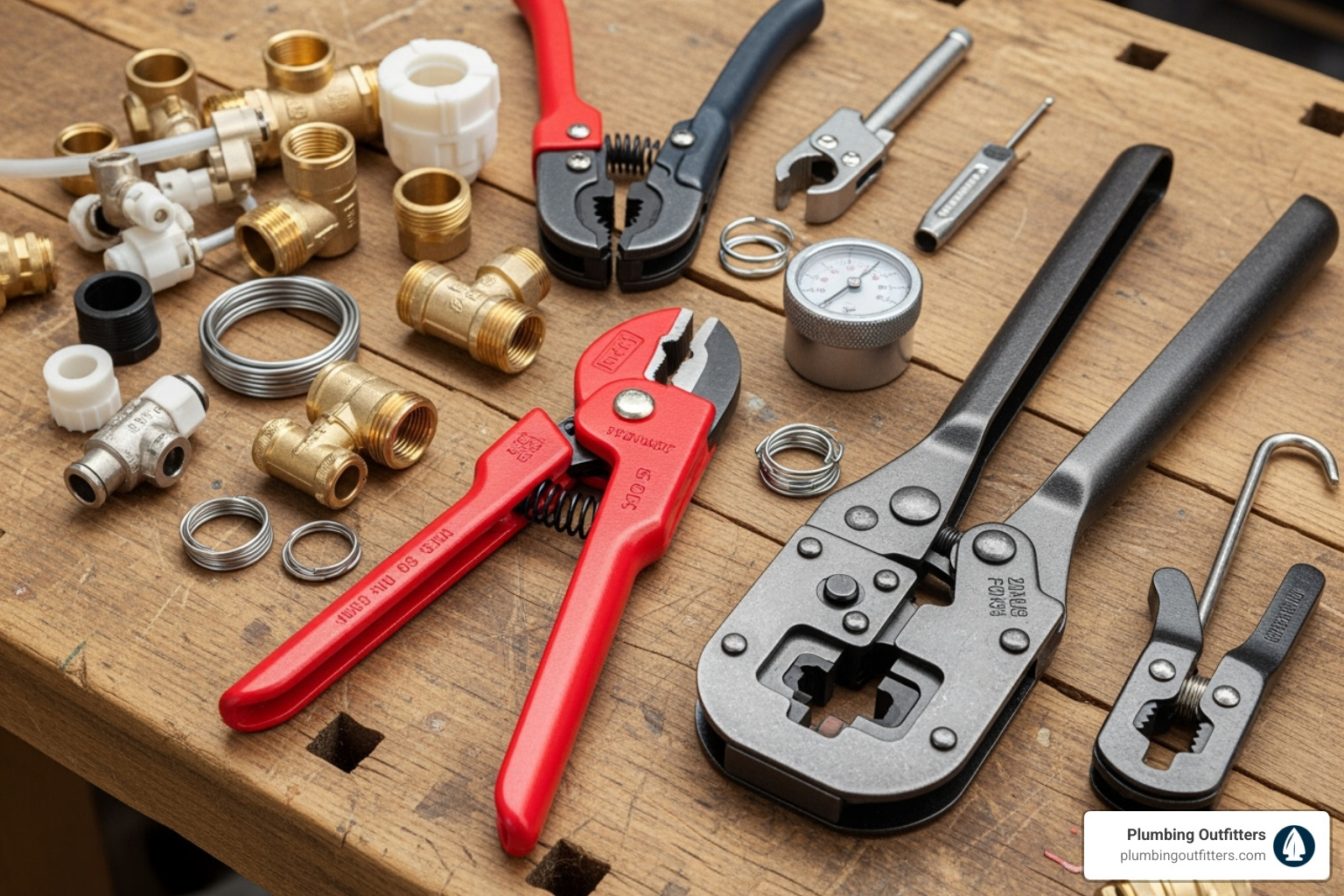
A PEX cutter makes clean, square cuts – essential for leak-free connections. It’s like scissors designed specifically for PEX tubing.
The crimp tool works with copper crimp rings, compressing them around the PEX pipe and fitting. You can find them in various sizes or grab a multi-size version.
A cinch tool (sometimes called a clamp tool) tightens stainless steel cinch clamps around your connections. One tool often handles multiple pipe sizes, and it’s fantastic for working in tight spaces.
The expansion tool is specifically for PEX-A tubing and expansion fittings. It expands the PEX pipe so you can insert the fitting, then the pipe shrinks back around it for a rock-solid seal. Battery-powered versions (like the Milwaukee M18 FUEL ProPEX Expansion Tool) are popular for larger projects.
Your go/no-go gauge is your quality control checkpoint. This simple tool verifies that your crimp or cinch connection is within the correct diameter range – basically making sure you didn’t crimp too tight or too loose.
Finally, keep a crimp ring removal tool handy. We all make mistakes, and this tool helps you cut and remove a copper crimp ring so you can salvage the fitting and try again.
Comparing Connection Methods
You’ve got four main ways to join PEX pipes, and each has its strengths. Crimp rings (copper) are affordable and reliable, requiring a crimp tool and go/no-go gauge. They’re time-tested and trusted by plumbers everywhere.
Cinch clamps (stainless steel) work beautifully in tight spaces where a bulky crimp tool won’t fit. The cinch tool is often more compact, and these clamps are just as reliable as crimp rings.
Expansion fittings (used with PEX-A) create incredibly strong connections. The initial tool cost is higher, but many pros swear by this method for its reliability and ease of use. The expanded pipe creates a tight seal as it contracts around the fitting.
Push-to-connect fittings are the quickest option – literally just push the pipe into the fitting. No special tools required beyond your PEX cutter. They’re perfect for small repairs, though they cost more per fitting and some local codes restrict where they can be used.
Storing and Handling PEX
PEX is tough stuff, but it does have one weakness: UV light exposure. Sunlight breaks down PEX over time, so always store it indoors or in a shaded area. If you’re running PEX outside temporarily during construction, cover it or get it installed quickly.
Handle your PEX carefully to avoid kinks. While PEX-A can often be repaired with heat, kinked pipe weakens the system. PEX comes in coils for longer runs (great for continuous lines with fewer fittings) and sticks (straight lengths) for shorter, straighter runs.
Keep everything clean. Dirt and debris can compromise your connections, so keep components clean and protected until you’re ready to use them. A little care during storage makes your actual PEX piping installation go much smoother.