
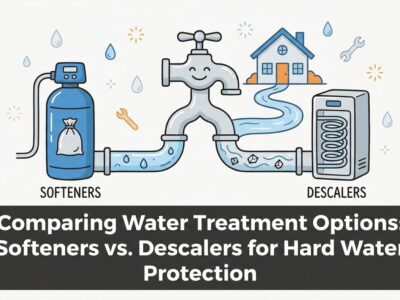
The Hard Water Dilemma: Choosing the Right Protection for Your Plumbing
When persistent white scale takes over your fixtures and appliances, looking at water treatment options comparisons for homeowners is the first step toward a lasting solution. That chalky residue on your showerheads and around your faucets is more than just an eyesore; it is a clear indicator that your plumbing system is under continuous stress. Many property owners face a confusing decision when trying to resolve this issue, often caught between traditional salt-based treatment systems and newer salt-free alternatives.
Finding the right system means understanding exactly what you are fighting against. In areas with high grains per gallon (GPG) hardness, choosing an underpowered system can lead to severe long-term plumbing damage. You need to know whether investing in traditional salt-based maintenance or opting for salt-free treatment makes the most sense for your specific property. Working with our experienced team at Plumbing Outfitters ensures you get the facts straight before making a major investment in your home’s infrastructure.
The true cost of ignoring the problem:
- Appliance degradation: Water heaters work harder and fail sooner when scale coats their heating elements.
- Fixture ruin: Expensive faucets and showerheads lose water pressure and eventually require complete replacement.
- Hidden pipe damage: Scale builds up inside your pipes out of sight, slowly strangling your home’s water supply.
Why Regional Aquifers Demand Specific Water Treatment
Generic plumbing advice often ignores the extreme mineral concentrations found in local water supplies. In our years of servicing Williamson County, we have seen firsthand how the municipal water is heavily influenced by regional limestone aquifers. As water filters through this porous rock, it dissolves massive amounts of calcium and magnesium. This process infuses the water supply with hardening minerals at levels that far exceed standard national averages.
Water hardness is measured in grains per gallon (GPG). While anything over 7 GPG is considered hard, local water frequently tests well above 15 GPG, classifying it as extremely hard. This extreme classification means that standard, off-the-shelf water treatment solutions often struggle to keep up with the sheer volume of dissolved rock entering your home.
The situation fluctuates throughout the year. Central Texas experiences extreme summer heat and frequent droughts, which actively concentrate the mineral deposits in the water supply. As water levels in the aquifers and reservoirs drop, the ratio of minerals to water increases, temporarily driving hardness levels even higher.
During the spring, our plumbers often see the results of this mineral and debris accumulation. In one recent case, our team helped a local family who noticed slow-draining water in their lavatories and tub shortly after moving into a new house. One of our technicians arrived, cleared the heavy buildup from the tub and one of the lavatories, and adjusted the stoppers to get the water flowing freely again. While not every slow drain is caused entirely by scale, a pattern we see often is that heavy mineral deposits create rough surfaces inside pipes that trap hair, soap, and other debris much faster than clean pipes do.
The Hidden Danger: Hard Water Scaling and Under-Slab Pipe Degradation
While crusty showerheads are annoying, the real danger of untreated hard water lies beneath your floors. As mineral-heavy water travels through your home, it leaves behind microscopic layers of calcium carbonate. Over years, these layers accumulate inside your pipes, acting like plaque in an artery. This buildup restricts water flow and forces water to squeeze through a much narrower opening.
This restriction increases the internal pressure against the pipe walls. When you combine this internal stress with external environmental factors, the risk of catastrophic failure skyrockets. Extreme weather causes the local expansive clay soil to shift drastically, putting immense pressure on under-slab plumbing that is already weakened by internal hard water scaling. When a pipe finally cracks under this dual pressure, water escapes beneath your foundation, creating a slab leak.
Proactive intervention is the only way to avoid invasive, expensive repairs. If you suspect your pipes are already compromised by severe scaling or shifting soils, scheduling our professional leak detection services can pinpoint hidden vulnerabilities before they flood your home.
Recognizing the Early Warning Signs of Pipe Stress
Hidden pipe degradation often sends subtle warning signs before a major rupture occurs. Keep an eye out for these indicators:
- Drop in water pressure: If multiple fixtures suddenly suffer from low flow, scale may be choking the main lines.
- Phantom water sounds: Hearing running water when all taps are turned off often points to an active under-slab leak.
- Unexplained bill spikes: A sudden jump in your monthly water usage usually means water is escaping somewhere unseen.
- Foundation anomalies: Visible foundation cracks or warm spots on your floor frequently result from hidden hot water leaks.
Salt-Free Water Descalers: Mechanics and Limitations
Salt-free water descalers, often marketed as salt-free softeners, use a completely different approach to handle hard water. Most of these systems rely on a process called Template Assisted Crystallization (TAC). Understanding how this works helps explain both its appeal and its shortcomings.
How the TAC process works:
- Hard water enters the treatment tank and flows through a specialized media bed.
- The media granules feature microscopic nucleation sites that attract dissolved calcium and magnesium.
- The minerals cluster together on these sites, forming stable, inactive microscopic crystals.
- Once the crystals reach a certain size, they detach and flow harmlessly through your plumbing.
The benefits of this system are highly attractive. There is no brine discharge to harm the environment, no heavy salt bags to carry every month, and virtually zero ongoing maintenance. Because the system does not use a regeneration cycle, it also wastes no water.
However, the critical limitation of a descaler is that it only conditions the water; it does not physically remove the calcium and magnesium. The rock is still in your water. While TAC works well in moderate hardness, our team typically sees these systems underperform when subjected to extreme mineral concentrations. When local water hits 15+ GPG, the sheer volume of minerals can overwhelm the media bed, allowing unconditioned calcium to slip through and form scale. If scale has already caused significant damage, you might find yourself researching the causes and repair options for slab leaks sooner rather than later.
Traditional Salt-Based Water Softeners: The Ion Exchange Solution
Traditional salt-based water softeners remain the industry standard for extreme high-GPG hardness, and for good reason. Instead of just altering the minerals, these systems physically extract them from your water supply through a process called ion exchange.
The mechanics of ion exchange:
- The resin bed: The main tank contains thousands of tiny resin beads heavily charged with sodium ions.
- The swap: As hard water flows over the resin, the stronger positive charge of calcium and magnesium knocks the sodium ions off the beads.
- The capture: The resin grabs and holds onto the hardening minerals, releasing a tiny, harmless amount of sodium into the water in exchange.
- The flush: Soft water exits the tank and enters your home, completely free of scale-causing rock.
Because the minerals are physically removed, this is the most effective way to protect water heaters, dishwashers, and household plumbing fixtures from scale. Your shower glass stays clear, your skin feels less dry, and your soaps lather much more effectively.
The trade-off is the maintenance requirement. Homeowners must regularly replenish the brine tank with salt. Additionally, the system must periodically regenerate, flushing the captured calcium and magnesium down the drain with a saltwater brine. However, this ongoing maintenance provides unmatched long-term protection against internal pipe degradation. By keeping the pipes completely clear of scale, a true softener drastically reduces friction and internal pressure, helping you delay or entirely avoid the need for residential repiping down the road.
Head-to-Head Comparison: Which System Best Protects Your Pipes?
When dealing with Williamson County’s specific limestone water, a standard pros-and-cons list is not enough. You need a definitive look at how these systems handle aggressive, high-GPG water. Standard descalers often underperform here because the sheer volume of dissolved limestone overwhelms the crystallization process. We recommend traditional salt-based softeners over descalers for this exact reason. In our extensive local experience, physical mineral removal is almost always necessary for true appliance and pipe protection in this region.
| Feature | Salt-Free Descaler (TAC) | Salt-Based Softener (Ion Exchange) |
|---|---|---|
| Mineral Action | Conditions minerals into crystals; leaves them in the water. | Physically removes calcium and magnesium entirely. |
| Maintenance | Virtually none. No salt required. | Requires regular salt refills and periodic regeneration. |
| High-GPG Performance | Often struggles or fails above 15 GPG. | Highly effective, even against extreme hardness levels. |
| Pipe Protection | Prevents new scale in mild water, but offers limited protection in extreme water. | Provides superior protection against premature pipe replacement. |
| Water Feel | Feels like normal tap water. | Provides a slick, smooth feel; soaps lather heavily. |
Navigating these choices requires clear, honest guidance. Recently, a local spring customer reached out to our team regarding several unspecified plumbing issues that required repair options. One of our technicians thoroughly explained the underlying problems, offered multiple repair avenues, and ultimately found a hidden solution that lowered the overall cost. The job was completed with integrity and honesty. You need that same level of transparent guidance when deciding how to protect your entire plumbing infrastructure from aggressive local water.


Frequently Asked Questions About Home Water Treatment
Is a salt-free water softener better than salt?
Salt-free systems are technically conditioners, not softeners, because they do not extract the minerals. Whether one is “better” depends entirely on your local hardness level. In areas with mild to moderate hardness, a salt-free system offers great low-maintenance benefits. However, in regions with extremely hard water, salt is required for complete mineral removal and adequate plumbing protection.
Do water descalers actually work on extremely hard water?
Descalers can prevent some scale buildup in mild to moderate conditions by altering how minerals behave. Unfortunately, they often fail to protect appliances when hardness levels exceed 15 grains per gallon. The sheer volume of calcium in extreme hard water overwhelms the conditioning media, allowing scale to form anyway.
Which is better for plumbing: water softener or descaler?
Softeners provide superior protection for pipes by eliminating the minerals entirely before they can settle. Preventing scale is the key to avoiding internal pressure buildup and subsequent leaks. Because descalers leave the minerals in the water, they carry a higher risk of scale formation if the conditioning process is overwhelmed.
Does a descaler remove calcium from pipes?
No, a descaler does not remove calcium from the water or the pipes. It alters the structure of the calcium so it does not stick as easily to surfaces. Over time, this conditioned water can slowly dissolve existing scale, but the heavy minerals still travel through your entire plumbing system.
How does hard water contribute to slab leaks?
Hard water deposits thick layers of scale inside your pipes, which restricts the flow of water. This restriction increases the internal pressure and degrades the pipe integrity from the inside out. When combined with shifting soils outside the pipe, this internal stress frequently leads to cracks and under-slab leaks.
Finding the Right Solution for Your Home’s Water Quality
Understanding your local water quality is the very first step in protecting your home from aggressive scaling and premature plumbing failures. Because extreme high-GPG hardness behaves differently than moderate hard water, generic solutions often fall short. The right treatment system provides long-term appliance protection, preserves your water pressure, and delivers lasting peace of mind.
We highly encourage readers to have their water professionally tested and their plumbing evaluated. Reviewing these water treatment options comparisons for homeowners ensures you make the right choice for your property. Reach out to our team at Plumbing Outfitters to explore exactly which system will keep your pipes clear and your home protected.